• Skip to main content
  • Skip to primary sidebar
  • Skip to footer

  • Home
  • About
  • Gallery
  • Classes
  • Trips
  • Books
  • Blog
  • Contact
  • Sign Up For My Blog

Blog

Quilt Floating

March 25, 2012 5 Comments

Free Motion machine quilting a large quilt on a home sewing machine can be a bit daunting. A few years ago I developed a system that makes free motioning a bit easier. I’ve been sharing it with my classes, but decided now to share it on my blog so that more quilters might benefit. I call the process Quilt Floating and it’s my way of suspending the weight of the quilt instead of fighting it!

There’s quite a bit of information to share, so I’d like to do it in two installments. This week I’ll be sharing the concept, supplies and basic information. Next week’s post will include the specific set up instructions for all who are interested.

Here’s a picture to give you an idea of what Quilt Floating looks like:

Before we get to the actual frame, there’s a few tips I’d like to share. If your sewing machine is in a cabinet – great. It is also helpful to have some support to the left of the machine. If you don’t have any, placing an adjustable ironing board there is a good solution.

If you don’t have a cabinet you will want to find a way to avoid “sewing on a mountain”, ie: with the machine perched on top of a table or desk. Even table extenders don’t solve this problem with a large quilt because pins and folds of quilt get caught on the edges. My best suggestion is to place a card table in an “L” against your kitchen table or a banquet table. Then set the machine on a tv tray in the inside corner with enough magazines to make the bed of the machine flush with the tables.

Now you’re ready to float the quilt. All of the supplies can be purchased at your local hardware store *.

2 Lengths of Chain (approximately 18” long – links should be 1 ½” long)

2 Bull Nose Clips (3/4”)  These can be found with office supplies. They are inexpensive and will clip and unclip the chain together very easily (not in the picture).

2 Slide Clamps (36” long)  Both the old fashioned “C” clamps that screw to tighten or the deluxe new ones that pump tight will work. Choose the best quality clamps you can afford. I took my husband shopping and thus I own the Cadillac of clamps, but at least I waited until they were on sale. They are very easy to use! It’s important to have a hole in the bar at the non-clamp end for a rod or bolt to go through.

2 Spring Clamps (6” long) These are plastic, fairly inexpensive and have holes in the handle ends. They squeeze to open.

1 Top bar 6’ long or long enough to fit the width of your table/cabinet. You’ll want the “Quilt Float” positioned about 1 ½ feet behind the sewing machine. Depending upon your space, you’ll need to choose a “top bar” option:

1. If your table/cabinet is less than 6’ wide and more than 1½’ deep you’ll want to place the clamps on the sides. For this arrangement you’ll need: 2 bolts and 2 wing nuts that will fit through the holes at the ends of the Slide Clamps and a 6’ piece of aluminum slat with holes at even intervals along the length.

2. If your table/cabinet is more than 60” wide and less than 2 feet deep, you’ll want to place the clamps along the back. For this arrangement you’ll need to buy a ¼” diameter Steel Rod (4’ long)

*If you quilt in a basement with exposed rafters you will only need the chains,  bull nose clips, spring clamps and a couple of nails!

Next week we’ll put it all together!

Window View Challenge Deadline Extension!

On another note – I’m having a lot of fun playing with new techniques on my “Window View” challenge. I’m thinking it would be a good idea to have an extra week or 2 to “get ‘er done” and so I’m changing the deadline from April 1st to  April 15th. I’d appreciate getting a picture of your finished project by then for posting on that week’s blog.

If you haven’t checked out the pictures of the current views, please click here. If you were thinking of participating, but needed more time, send me a picture of your view and jump on in!
Tying Up Loose Threads, Pulling Up Bobbin Threads

August 8, 2011 4 Comments

I was blown away by all the interesting comments concerning our sewing machine collections. I learned a bit of history and discovered that I don’t win the ribbon for having the most machines :-). If you haven’t been reading the comments on any of my previous posts, it’s really quite simple: go to the bottom of that post,  and click on “comments”  (the word will be in blue)!

Also, if you want to comment on my post directly to me, you can just send me an email (and I thank those of you who do). I enjoy reading these, but I often wish they had been posted as a comment to that post so others could read them too. It’s easy to make a comment to a post: once again click on the word “comment” at the bottom of that post and scroll down until you see the “comment box”, type your comment and submit.

Now for the bobbin thread tip!

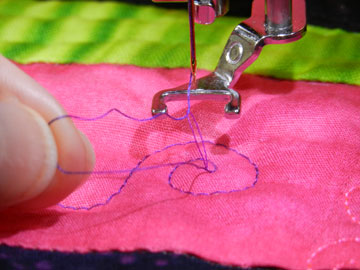
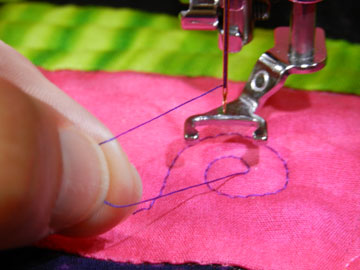
When I’m quilting on a large quilt and reach the end of a stitching line, I find it awkward and difficult to reach under the quilt and cut the bobbin thread. I do have a machine with a “cut” feature, but it leaves 1″ tails. I don’t like to have them hanging around and I really don’t want to go back and trim them all off later. If you struggle with this frustration too – here’s the answer:

1. Raise the needle at the end of your stitching line.

2. Raise the presser foot.

3. Grab the thread between the needle and the quilt and pull out a loop.

4. While holding the loop of thread, reinsert the needle in the hole the thread came out of (or close to it),

and then bring the needle back out. This works great if you can just press “needle up/needle down” on your machine to make one complete stitch.

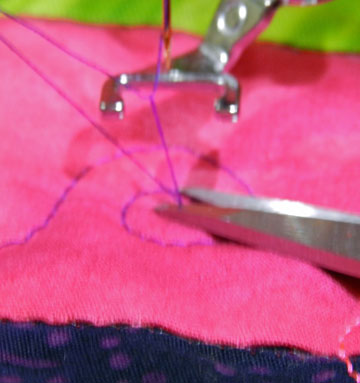
5. While still holding the original loop, raise the foot again and pull the quilt away from the needle. The bobbin thread will pop up in a small loop.

6. Cut the bobbin thread loop and the top thread close to the quilt.

Voila! It’s almost like magic 🙂.

This also works when you want to pull the threads both to the top and knot them off for burying as was discussed in my “Loose Ends” post from March 27th (click on “Loose Ends” and scroll down for that lesson).

Try it! I think you’ll like it!

Hurry Up or Wait

June 28, 2011 7 Comments

While reading an issue of Irish Quilting Magazine I came across a comment I spent some time contemplating: “never be in a hurry to finish a quilt”. Now, my first response was that it was good advice, but I soon discovered that there are times the opposite can be true. Let me explain :-).

The article went on to say that “most of the time when we’re in a hurry, mistakes happen”. This can certainly be true and I decided I agreed. A day or so later I realized it was time to do a bit of tidying up in my studio and ended up staring at one of my recent (I use the term loosely) projects. It is my version of a mariner’s compass on drugs. About a year ago I started drafting a bevy of amoeba shaped compasses that interconnected, and I was pleased with the design. I had it enlarged and then agonized over a color scheme. Once that problem was solved the piecing was great fun. It turned out so well I decided I needed a truly wonderful quilting design and began to ponder what I could do that would take the quilt over the top – I didn’t want to rush into anything.

The top has been hanging on my design wall since March :-(. I was telling myself it was marinating, but now its simply frustrating. No amazing quilt design has materialized and I’ve gone way past the stage of rushing into something!

So, while staring at this piece that used to make me smile I realized that there is a happy medium for everything and at that moment my own advice, which I often share in my Beyond Meandering class, resounded in my ear:

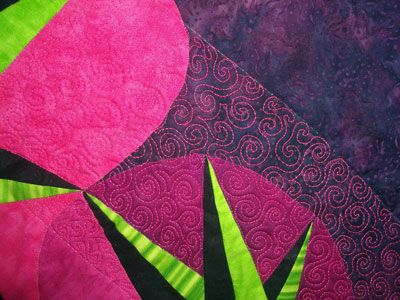
When choosing a quilting design don’t say to yourself “a judge would appreciate feathers”, but rather “what would be fun to do today?” I was looking for the perfect design and it wasn’t forthcoming…. so I made the decision at that moment that my favorite free mo design is spirals and they’d be more fun then cleaning so I set up the machine and had a ball! I’m not ready to show the whole thing – and there’s more quilting left to be done – but I’m back to excited again. Here’s a picture of some of the fun.

So, don’t rush, but don’t let the moss grow on your quilt either. The perfect quilting design is the one you are in the mood to do today!

Design Your Own

May 14, 2011 8 Comments

During our Irish “Sew We Go” adventure many of the quilters signed and exchanged Irish Chain blocks. I pieced mine together into a friendship top shortly after we returned… and then it sat. This past week I decided it was time to quilt it, but how? It was easy to decide to do some straight line quilting through the chains. Then I felt a Celtic Knotwork motif would be nice in the signature blocks, but I didn’t have a stencil. I was pleased with what happened next and thought you might find it interesting and, hopefully, helpful.

I began by pulling out my June Tailor “Mix ‘n Match Templates”™. Each package contains 6 different sizes of a chosen shape. I’ve found them to be a wonderful tool and own all their shapes, but you can also find great templates at the Craft Store. Check out the kid’s foam pieces or wood cutouts there.

A few years ago it was suggested to me that quilts could be marked with Crayola Washable Markers™. I was very hesitant, but decided this would be a good time to try them. I did a test piece first and the marker washed out well. So, I used it to mark the entire quilt and, once the quilting was done, I threw the whole quilt in the washer and it came out great. I’d do it again, but I recommend testing it on every fabric it will be used on.

Sample block, templates and washable marker

Now I was ready to create a design. The packaged “feather” template, shown in the package above, didn’t work, but the small “leaf” template fit into the areas on the center of each side, so I drew them in. I could have connected them, but felt it needed a bit more. I couldn’t find a “tear drop” template, so I drew one of my own and cut it out. Then I traced around both templates until I was pleased with the placement of the shapes.

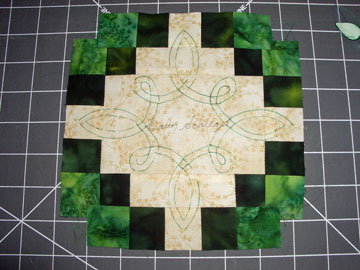
Celtic Designs usually are not made up of lines, but visual “tubes”, so I needed to “widen” my lines. I drew these free hand about 1/4″ away from the first lines inside each shape.

Next, I needed to connect them and did this free hand too. You’d be surprised how easy this is with only a bit of practice!

Taa Daa!

Drawn and ready to free motion quilt (except this is an extra block and I actually had to draw it in each block on the quilt).  Here it is quilted:

I had so many blocks to quilt that I decided I didn’t need to have the design look like it wove “over and under” at each intersection. Thus the entire block could be done as a continuous line by starting at any crossed line intersection on the pattern.

The best part about creating your own design this way is that you can make it fit your project whenever you’re ready. You never need to have the perfect stencil in your stash.

Have you done any of your own designing? Are there any tools that work well for you? If so, please share :-).

Mischievous Blues

March 3, 2011 4 Comments

The latest Milwaukee Art Quilter’s challenge is entitled “The Blues”. The quilt needed to be 31″ square, at least 1/2 blue and fit the theme. My grandson Willy has the most beautiful blue eyes, so my subject matter was simple. However, creating him in fabric was truly a challenge. I have done very little in the way of faces, so this was a great learning opportunity. I used a mixture of Repliqué  and my version of Caryl Fallert’s Appli-piecing technique, all accented with thread painting.

So here’s the picture of Willy with big sister Hanna:


and here’s the quilt:

As you can see, the real Willy’s a whole lot cuter than the quilt Willy, but overall I’m pretty happy with my first attempt and have learned a lot. We all need to try new things :-).

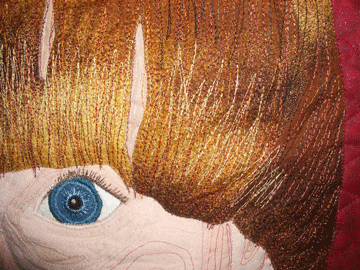
The one part I was pleased with was his hair and that (along with his eyelashes) was my thread painting adventure.

I used a fabric which contained areas of all the right values of golden red to brown, appli-pieced chunks of it together and then the fun began. I changed thread often and truly scribbled horizontally all over. It was freeing and almost fool proof! A great technique to have in your bag of tricks. I hope you have the chance to try it!

  • « Go to Previous Page
  • Page 1
  • Page 2
  • Page 3

Primary Sidebar

Archives

Recent Posts

  • London ~ and More
  • Designed For a Purpose
  • Squirrel Quilts and More
  • Vintage Appliquéd Arrows and More
  • Fascinating Tidbits

Recent Comments

  • Karen Ann Moore on London ~ and More
  • Cheryl McLean on London ~ and More
  • Sue Halpern on London ~ and More
  • judy raddatz on London ~ and More
  • Joanne Corrigan on London ~ and More

Categories

Footer

My Guide

Whatever you do, do your work heartily, as for the Lord rather than for men.

—  Colossians 3:23

Contact Chris!

  • Home
  • About
  • Gallery
  • Classes
  • Trips
  • Books
  • Blog
  • Contact
  • Sign Up For My Blog

Copyright © 2026 · Chris Quilts · Website by Adunate · Privacy Policy