• Skip to main content
  • Skip to primary sidebar
  • Skip to footer

  • Home
  • About
  • Gallery
  • Classes
  • Trips
  • Books
  • Blog
  • Contact
  • Sign Up For My Blog

Blog

Compass Capers

April 15, 2012 4 Comments

I’d like to send a big thank-you to everyone who commented on last week’s blog post with opinions on classes. I was very pleased with all the suggestions and will really take them into consideration when planning new projects!

Now for my exciting news:

Compass Capers – Create Your Own Unique Mariner’s Compass Quilt is now in print and available on my website!!!

Thanks to all who sent suggestions for the book name or voted for their favorite in the previous post. This title was the winner that made the front cover with a good majority of the votes:
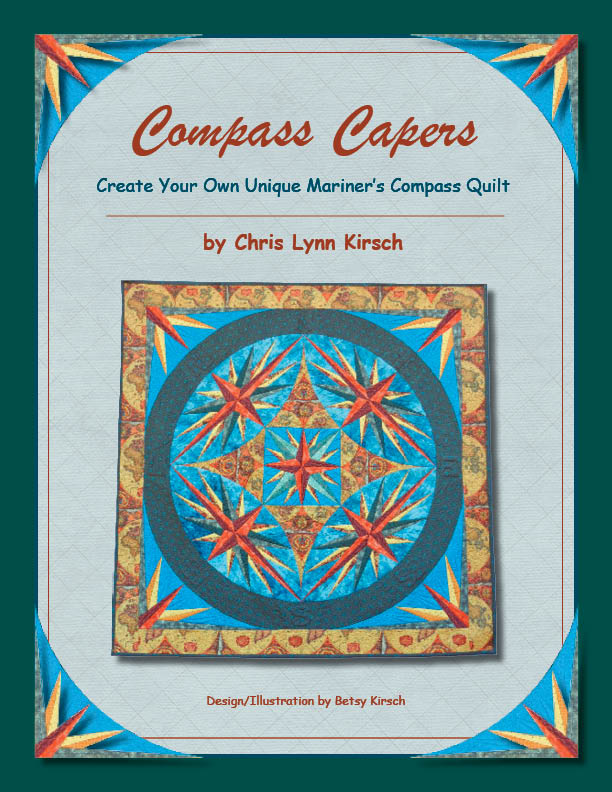
Compass Capers - Create Your Own Unique Mariner's Compass Quilt

The runner up book name was one of my husband’s suggestions and it made the back cover:
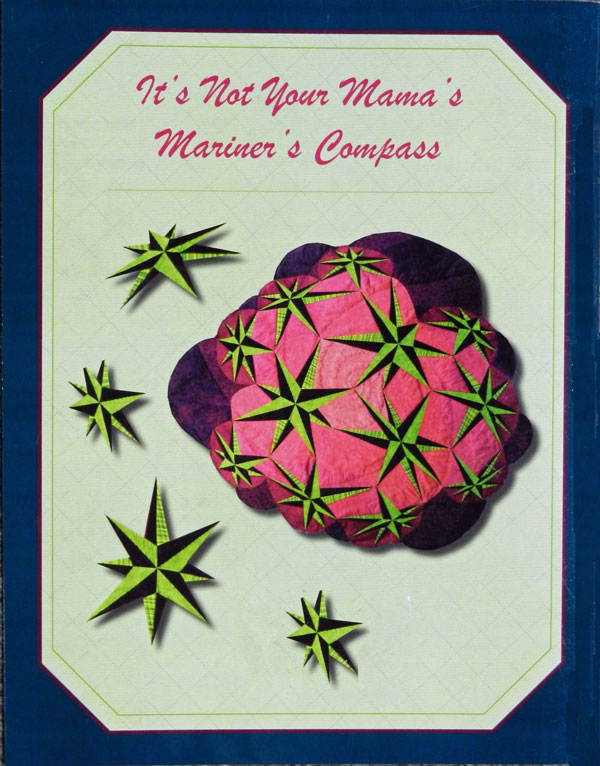
Compass Capers book, back cover

Inside you’ll find instructions for drafting compasses any shape or any size. It’s not difficult because it’s done with paper folding techniques and there are pictures every step of the way. Then learn to paper piece your creation with clear step by step instructions and loads of pictures once again.

There are also photographs of many of the Mariner’s Compass quilts I’ve created over the years.

Most Mariner’s Compass books limit the pattern options. Compass Capers is different. By letting you decide on the shape and size of your blocks, the pattern options are endless. Your imagination is your only limitation!

To order your own autographed copy, click here!

Friendship, Travel and Autograph Quilts

March 4, 2012 3 Comments

Quilting friends are the greatest and traveling with quilting friends is an absolute joy! When Wendy and I lead our Sew We Go adventures we always have a “pre-trip” project and a “take along” project. The pre-trip projects for the past 5 tours have included autograph blocks that we exchange while traveling. They’re a wonderful way to preserve memories just like the Album Quilts our grandmothers used to make.

Each trip we choose a block and all those who desire to participate make enough blocks to exchange, as well as enough extra blocks to complete the chosen pattern.

Our Danube Cruise block was paper pieced in shades of blue and green to evoke memories of gentle waves. 

This type of piecing guarantees all the blocks will fit together .

On our Holland Cruise we had everyone make “flying geese” that could be put together into a Dutchman’s Puzzle block.

I also had my geese fly between the other portions of my quilt.

While floating through the south of France we exchanged Indian Hatchet blocks (that’s the block’s name, I didn’t make it up).

I chose to make my blocks into a tote bag.

The Irish Chain pattern was an obvious choice for our trip to Ireland. There are 2 blocks in this quilt: each quilter made checkerboard blocks and background blocks out of batiks and we signed and exchanged only the background blocks.

This is such a lovely pattern!

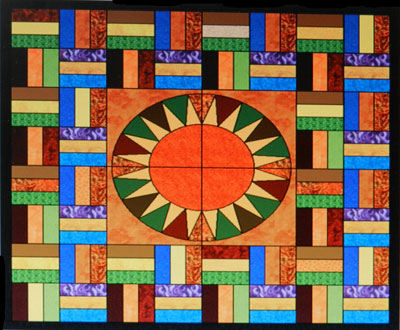
Wendy and I are so excited about our next Sew We Go adventure. We’ll be traveling through Italy this coming October and here’s a preview of the design for our Tuscan Sun friendship quilt. We’ll sign the middle rails in the rail fence blocks:

Rome, Sienna, Florence, the Vatican!

Art, Sights, Food, Wine!

It promises to be a wonderful trip and there are still a few spaces available. Click here for all the information!

Do you have any special autograph quilts? Please send pictures to my email, , and I’ll post them in a future blog!

Simply Dynamic

February 26, 2012 4 Comments

Here’s an easy way to have a little design fun. Choose a simple 6″ block that has a strong diagonal, and make it in 2 high contrast fabrics. The possibilities will be even greater if you make positive and negative versions of the block. These are the 2 blocks I started with:

 
I made 24 blocks – 12 light and 12 dark.
*
*
*
*
Now the fun begins. Let’s start with the blocks set side by side and in the same orientation. I’ve put all the darker blocks in the arrangement on the left and all the lighter ones on the right.
*
*
*
*
Sweet, but not very exciting. Let’s try alternating the dark and light blocks while still keeping them in the same orientation:
*
*
*
*
Now we’re getting somewhere….but what if we divided the darks and lights up once again and butted the 2 halves together….while turning every other block?
*
*
*
*
Now let’s go a bit crazy!
*
*
*
*
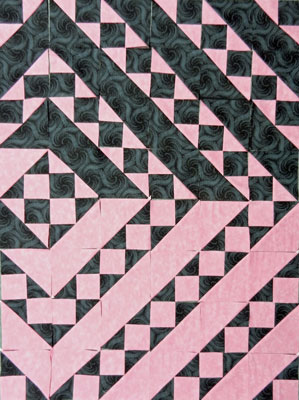
At this point I think I need to double the number of blocks and try playing a little more with the symmetry:
*
*
*
*
That’s my favorite so far! Here are a few more I came up with:
*
*
*
*
*
*
Sew many options!
To help in my decision making I took a picture each time I tried something new and then pasted them onto a page on my computer screen to compare them all and glean out the best (I didn’t show the klinkers :-). That’s where I got the idea for this post.
Any block with a strong diagonal can be played with in a similar fashion. Have you used similar blocks in a unique set? If so, please send pictures!

Flange in Photos

October 2, 2011 7 Comments

Natalie commented that she’d like more instructions on inserting the flange from last week’s blog. So here goes…and with pictures 🙂

1. Cut a strip from contrasting fabric 1″ x the length of each side for a ¼” wide flange or 1 ½”  x the length of each side for a ½” flange.

2. Press these strips in half, lengthwise, wrong sides together.

3. Lay a flange along one side of the the quilt top, keeping all raw edges even and pin in place. Repeat on the opposite side.

4. Repeat for the remaining 2 sides.

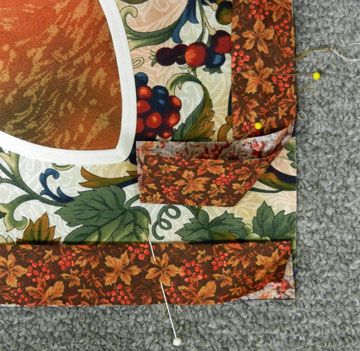
Here’s a close up of the “keeping the raw edges even” part:

5. If you’re adventurous, you may leap to step 6. If you’re cautious, you may stitch the flanges in place with a basting stitch, all the way around. Use a seam allowance that is shy of ¼” so these stitches won’t show later.

6. Border quilt as usual.

By basting the flanges in place in this way, the flanges look as if they are just a narrow border.

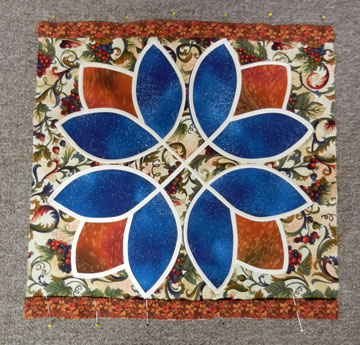
It is “legal” (remember – there are no quilt police) to just tuck the flanges into each border seam as the borders are sewn on without cutting them to fit and basting them in place, but  then you get a different look as in this tumbling blocks quilt:

This look isn’t wrong, it’s just different.

One warning with flanges – they lay on top of the quilt and extend into it ¼” or ½”. If there are triangles pieced to the edge, the flange will lay over them and the points will be lost. So they work best on non-pieced outer edges or between plain borders.

Flanges may also be added just before binding.

If you’ve never tried a flange – I highly recommend you do :-)!

A Pressing Issue

April 17, 2011 3 Comments

Many years ago my quilting teacher, Sharon, taught me the ABC’s of quilting:

A is for accurate

B is for be accurate

C is for continue to be accurate

And then know how to fudge when things don’t work :-)!

Many quilters think that pressing is a relatively unimportant topic, but I disagree. We have wonderful tools for cutting extremely accurate pieces; then we strive to sew a perfect “scant quarter inch seam allowance” on our fantastic sewing machines; only to “iron” them with steam while stretching and smashing them all out of whack. So much for accuracy.

I’ve found that if I press (not iron) my seams – to the side – with a dry iron I can virtually eliminate the need to “square up”. In my opinion, if I rotary cut 100 squares and sew 50 pairs from them, then I carefully press each pair flat; I’ve handled them enough and I don’t feel like wasting more time recutting every one to the size I need. Life is just too short for the extra step if it’s easy to avoid. So how do I press without distorting?

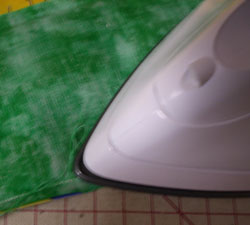
1.  After sewing the seam, lay it down unopened and press the dry iron down at one end of the seam, lift, move and press again without sliding the iron. Continue until the entire seam is pressed. This sets the stitches and gives a crisper result.

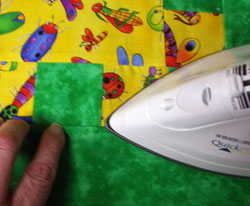
2. Fold the top fabric down over the seam and finger press. Once it’s flat, place the hot, dry iron on top of it. Move your fingers down to the next portion, followed by the iron again and repeat for the entire seam.

It’s been working well for me. So………do you agree? If you haven’t tried it, please do and let me know what you think.

PS In my original posting of this blog message, my wording gave the idea that I press the seams open. I almost always press to the side and have made the correction above. Thanks to those who spotted it :-).

PPS I do use steam when the quilt top is done and I want to encourage it to be as perfect as possible :o).

  • « Go to Previous Page
  • Page 1
  • Interim pages omitted …
  • Page 3
  • Page 4
  • Page 5

Primary Sidebar

Archives

Recent Posts

  • London ~ and More
  • Designed For a Purpose
  • Squirrel Quilts and More
  • Vintage Appliquéd Arrows and More
  • Fascinating Tidbits

Recent Comments

  • Karen Ann Moore on London ~ and More
  • Cheryl McLean on London ~ and More
  • Sue Halpern on London ~ and More
  • judy raddatz on London ~ and More
  • Joanne Corrigan on London ~ and More

Categories

Footer

My Guide

Whatever you do, do your work heartily, as for the Lord rather than for men.

—  Colossians 3:23

Contact Chris!

  • Home
  • About
  • Gallery
  • Classes
  • Trips
  • Books
  • Blog
  • Contact
  • Sign Up For My Blog

Copyright © 2026 · Chris Quilts · Website by Adunate · Privacy Policy