Natalie commented that she’d like more instructions on inserting the flange from last week’s blog. So here goes…and with pictures 🙂
1. Cut a strip from contrasting fabric 1″ x the length of each side for a ¼” wide flange or 1 ½” x the length of each side for a ½” flange.
2. Press these strips in half, lengthwise, wrong sides together.
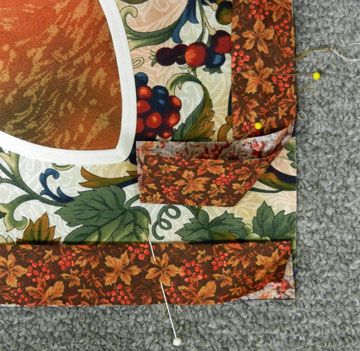
3. Lay a flange along one side of the the quilt top, keeping all raw edges even and pin in place. Repeat on the opposite side.
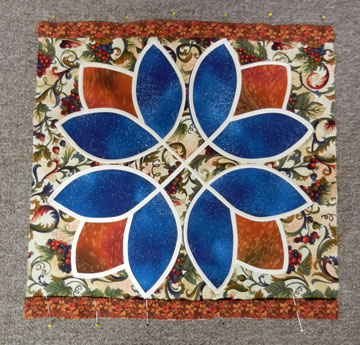
4. Repeat for the remaining 2 sides.

Here’s a close up of the “keeping the raw edges even” part:
5. If you’re adventurous, you may leap to step 6. If you’re cautious, you may stitch the flanges in place with a basting stitch, all the way around. Use a seam allowance that is shy of ¼” so these stitches won’t show later.
6. Border quilt as usual.
By basting the flanges in place in this way, the flanges look as if they are just a narrow border.
It is “legal” (remember – there are no quilt police) to just tuck the flanges into each border seam as the borders are sewn on without cutting them to fit and basting them in place, but then you get a different look as in this tumbling blocks quilt:

This look isn’t wrong, it’s just different.
One warning with flanges – they lay on top of the quilt and extend into it ¼” or ½”. If there are triangles pieced to the edge, the flange will lay over them and the points will be lost. So they work best on non-pieced outer edges or between plain borders.
Flanges may also be added just before binding.
If you’ve never tried a flange – I highly recommend you do :-)!

JoQuilter says
Chris, what you call a flange I call a flippy. Yes, they are the best for added just a bit of visual interest.
Carmen Sommers says
I was told it was called piping (Harriet) I use them mostly in table runners for interest.
Natalie Rainford says
Thanks! I’ll have to try this, if I ever get my sewing machine back from the shop!!
Joanie Oberfoell says
The fabric used in pictures 1 and 2 for the “flange/piping” has been a
big seller at our JoAnn’s. I have used this technique as 3 D using a pre shrunk really skinny drapery cording(1/8 inch) on many quilts/wallhangings for the “pop” where points won’t be blocked or cut off.
bonnie says
I’ve used this technique for wall quilts, lap quilts and larger quilts. It really pops out a color that gets lost in the quilt depending on what color you choose for the phlange (I call it piping). Can take a good quilt and make it a great quilt. Give it a try. it takes time but its worth every moment. bonnie
Wemdy says
Today, October 4th is Chris’ birthday! Happy birthday Chris!!! May God bless you with another wonderful year
Sandlin Poth says
Happy belated Birthday, Chris!! Many blessings for another marvelous year! You share it with my sister-in-law, among others! I used the flange technique when I was in charge of putting the Heritage quilt together to, as one of the comments mentioned, give it that extra “pop”! I need to remember to use it more often and good reminder about WHERE to and not to use it! Sandlin in Galway