• Skip to main content
  • Skip to primary sidebar
  • Skip to footer

  • Home
  • About
  • Gallery
  • Classes
  • Trips
  • Books
  • Blog
  • Contact
  • Sign Up For My Blog

Blog

Beading the Sun

July 4, 2021 4 Comments

Happy Independence Day! With all the recent days of sunshine and heat, I thought it was a great time to tell you about my most recent project. It came to be with inspiration from three different directions.

I received a comment from Karen to a recent post about my mailing tape beading technique (click here to link to that post):

“Let us know when you will be teaching another class in adding beads to a quilt.  I have tons of beads and need some ideas on how to use them on a quilt.”

This got me to thinking that I haven’t done any beading classes for a long time. Then the ThreadBenders group chose a small challenge theme of “Sun”. This challenge had very few rules – “make a quilt with a sun on it” 🌞 . On top of that I was excited about the wonderful way Clara embellished a wall hanging with fasteners (click here to read it). This all came together in my brain and I jumped right in to my beaded sun quilt.

So where did I begin? Well – I needed to have a base for my beading and it needed to contain the sun. I chose a wonderful, bright hand-dyed fabric for the sun and a beautiful blue hand-dyed fabric for the sky. These were fat quarters from my stash and the colors alone made me want to continue. I drew an appropriately sized 1/4 sun (it seemed to fit best) on a piece of freezer paper, cut it out, ironed the shiny side to the sun fabric, and layered it with the sky. Then I stitched along the outside of the paper, through both layers.

all the way around.

The paper was peeled away and the excess sun fabric was trimmed next to the stitching, ala my raw-edged Repliqué technique.

Leaving me a wonderful top to embellish.

I trimmed the sky fabric away from behind the sun to reduce bulk (and who would want to waste any of that beautiful fabric?)

During this entire process I was contemplating where and how to embellish. Stay tuned to next week’s post to see where I went from there!

A Time Saving Machine

May 23, 2021 7 Comments

Last week Joanne commented that she wanted to know more about my Brother Scan ‘n Cut™. I’m actually using it on a current project and it is such a time and “hand” saver. Let me start at the beginning 😊.

A few years ago you might remember I made a quilt entitled “How Beautiful – Liberty”. It was one of my accordian door quilts, so it was made as 3 quilts: 2 were cut into vertical slices and sewn back together alternately, and the third was the base for the others to hang from. When viewed from the front the center portion is a bit confusing:

But by simply moving a few feet to the left you can see the New York Beauty quilt,

and viewed from the right the true New York Beauty appears!

While making the base quilt I wanted to include the first sentence in the Declaration of Independence, but how to make those tiny letters??? My husband suggested there must be a device that would save me from all that intricate and laborious cutting. So I called my friend Wendy at Sew Much More and she recommended the Scan ‘n Cut™. I did a post on how well it made the letters back in 2015 and you can click here to read all about it.

Since then I’ve used the Scan ‘n Cut™ for a variety of projects with great results. Many letters and shapes are loaded in the machine’s memory, so many projects can be created on the screen. Plus Brother™ has a site on the web called “Canvas” in which many, many more projects and alphabets can be found.

I made the words for my postcards featured in last week’s post with an alphabet in the Scan ‘n Cut™.

This week I began a new project in which I wanted to make 6 identical moths in fabric. I found a photo I liked

and traced the 3 different colored areas onto the paper side of fusible web. I ironed them to the appropriate fabric, cut them out by hand, and fused them all together. It worked, but my hand ached. That’s when I remembered the scanning feature on my Scan ‘n Cut™. I traced those 3 shapes again, onto paper this time, and placed it on the sticky area of the Scan ‘n Cut™ mat.

I loaded it into the machine, but this time I used the scanning feature to save my image in the Scan ‘n Cut™ memory. I was able to crop out the empty moth body shape in my scan and duplicate it 5 times on the screen to create my first “project”. I ironed the fusible web to the back of the black fabric, put it on the sticky mat, and chose the cutting feature this time to cut out 5 identical black moth bodies.

I was thrilled. I left the paper from the fusible web on the back of these shapes and went back to my original scan to crop out the shape to be cut from the dark blue fabric. I made a new project screen with 5 of those shapes. They were rather intricate and this time I was not thrilled 😟. The machine didn’t cut the tiny areas well at all and everything bunched up, and there were many areas that didn’t even cut through (sorry, I was frustrated and didn’t think to snap a photo).

It was then I had a lightbulb moment. I’ve been using this machine for over 5 years and never changed the blade. The size of the blade and the way it works is mind-boggling to me. This is what you see of it in the holder (it’s so tiny I had a difficult time getting a clear shot):

I decided to watch a few videos about it before purchasing a new blade and realized the whole area needed regular cleaning (duh). I took the unit apart and it was full of lint. I cleaned out the case with a dry cotton swab:

and used it to wipe off the blade also:

Once it was back together it cut the dark blue pieces perfectly! I fused them onto the black moth bodies.

The light blue portion of the wings was just as intricate – and the machine did a wonderful job! The background cutaway on the right is just laying on the mat loosely after I pulled it away from the wing pieces (please ignore the black lines on the mat – they were an oops from a previous project):

After fusing these final pieces in place

I was very pleased!

And so happy I didn’t have to cut it all out by hand. My hands don’t do the intricate cutting as well as they used to, so this machine is a real blessing to me!

The additional detail on the moths will be stitched in. These moths will be part of a new challenge quilt I’m making. Stay tuned to see what comes of them!

Raw-edged Repliqué

May 10, 2020 Leave a Comment

Happy Mothers Day to anyone who is a mom or has/had a mom ?! I had a lovely lunch today with my Mom, and I’m very blessed to still have both of my parents healthy, active and in in my life!

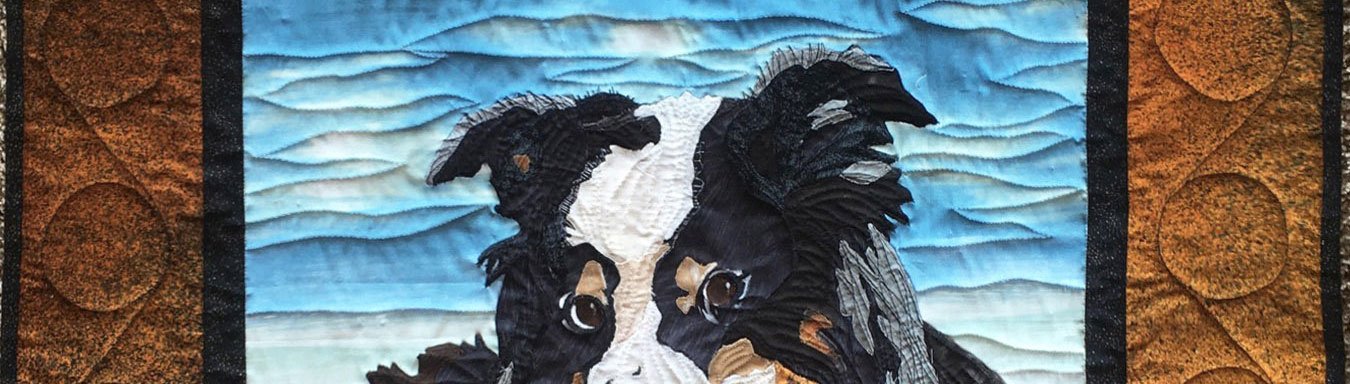
Recently, at the end of a post, I shared a photo of a quilt I gave to my son’s family after the passing of their dog Moseley.

I started that quilt in a workshop with Barbara Beasley. Her quilts are amazing and her technique is very interesting. To read my post about that class click here.

I have to admit that I found using fusible in a “jigsaw puzzle” fashion, with all of it’s reversing and cutting, a bit tedious. So, it wasn’t really my thing. But… Brad, Betsy, Sommer and Trey have another dog who is also 13 years old, and I felt this time of being “safe at home” would be a good opportunity to make a quilt of Nershi too. I decided to create this quilt with my raw-edged repliqué technique because it doesn’t require fusibles and pre-cutting. Click here to read a tutorial I did on this technique last year!

I found a good photo of her – but something was missing:

With Nershi it is all about the ball. As soon as you sit down in their home a ball is dropped in your lap, in the hopes that it will be thrown – over and over again. So I found an image on the web that would work:

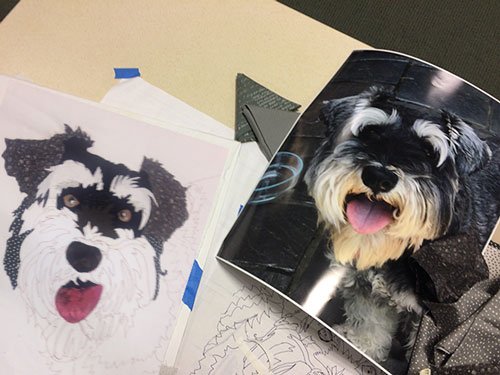
I enlarged the photo of Nershi, inserted the image of the ball, and printed it out. Years ago I discovered a way to do this using MS Excel on my computer – Once the directions are completed and print is clicked, all of the portions print out, ready to be taped together. To visit that post and learn how to print enlarged photos from your computer click here and scroll past the Irish chain quilt.

So I taped the enlarged photograph together, placed it on a light box, and traced all of the different shapes and areas to the back of the enlargement.

This step is a bit tedious, but I rather enjoy it. I then chose my fabrics and determined which ones go where by referring to the original photograph. The first part I do is the eyes, using white paint for the sparkle. I stitched the darkest fabric on next using my repliqué technique, but skipping the satin stitching step. As I add each area, I color it in on the pattern. Here it is from the front with the eyes and black fabric added:

I continued adding fabric from darkest to lightest in this way until the dog and ball were done. Then I cut her out from the paper and pinned her to the background fabrics. To add the shadow under Nershi I saved that portion of the paper pattern, taped it in place on the back of the grass fabric, and raw-edged repliquéd the shadow with black tulle.

Next I free-motion stitched Nershi to the background all the way around, cut the background away from behind her, and removed the paper.

The raw-edged repliqué was complete!

It was time to add borders, batting and backing, and to have fun free-motion quilting!

She was done in time to gift to my family for Easter!

I do prefer this method for creating animal portraits in fabric, but now I’m ready to move on to something completely different. Maybe it’s time for some piecing ?.

******************

Hankies – the topic that continues to make us smile!

This past week Margaret sent me another “hankie email”. I’m really loving the responses to that post! I think you’ll enjoy the clever memory boxes she made:

“About 15 years ago, my mother came up with this idea to give to each of
her (4) grandchildren, so I made it happen.  Each memory box contained
one of her hankies & a pair of earrings, one of my dad’s ties with a tie
clip, a copy of their wedding invitation (1944), and a copy of our
family picture (1964).
“

Beautiful! Thanks Margaret!

Then my friend Maureen also sent me a photo of a favorite hankie from her collection, since she was born in Wales, and a book she owns with many ideas for using hankies.

I did an internet search and was able to find copies of this book available for sale.

I asked her about being born in Wales and she responded:

“My mother was a War bride from Neath, Wales. My father was a cook and truck driver serving in England.  I don’t know how they met but my mother told me they dated only three months when he proposed to her!  When my father returned to South Dakota after the war (1946) my mother came to America with me on a boat with other war brides. The captain of the boat woke them up in the middle of the night so they could see the Statue of Liberty as they arrived in New York. We rode a train to South Dakota.”

What an interesting story. Thanks for sharing Maureen!

Rick-Rack Curves

September 1, 2019 3 Comments

I’ve discovered a fun new border technique that looks much more difficult than it really is. The secret is rick-rack!

It’s actually a lot of fun to make, especially if you put squares in the corners so you don’t have to figure out how to make the sides come together ?.

Here’s how:

Measure the sides of your quilt top and cut background border strips at this measurement by your desired border width (this is my pink fabric and the four borders were cut 18 1/2″ x 5 1/2″)

Next – cut a piece of freezer paper at this measurement and fold it in half, then into quarters, and continue until it’s at about 3″ or 4″ wide. Then draw an “S” as in the photo below and cut out along the line (be sure the line begins at the bottom left, at least 1/4″ from the edge for stability).

Cut along this line. Open the paper patterns out and lay each along a border strip to see which curve looks best. Iron your chosen pattern to the right side of the second border fabric, shiny side down.

Cut 1/4″ away from the paper the entire length.

Peel the paper from the fabric and lay the rick rack so the bumps are just touching the curved edge on the right side of the fabric. Stitch in place down the center of the rick rack. When using the standard jumbo rick-rack, this stitching will be 1/4″ from the edge. (My thread matched in my original image, so it didn’t show – I added the dotted line to the photo to make it more obvious).

Fold the rick-rack to the back along the stitching and press (I didn’t think the dotted line was necessary this time ?).

Place this piece along the long edge of a border strip, right side up, and stitch in the ditch, on the rick-rack, in a thread color to match the rick-rack.

Repeat for the opposite border and attach both to the quilt.

Make the borders for the remaining sides. Cut the corner squares at the same width as the borders and sew one to each end of these border strips. Then add them to the quilt top.

It’s all done by machine and I think this border adds a lot of excitement to the quilt.

Please try this technique and let me know what you think. I’d love to see pictures!!!

Oak Leaf and Swirl – Part 2

June 3, 2019 3 Comments

I had a number of readers ask about the thread/machine I used to do the quilting in the background of this quilt. I have a Handi-quilter Sweet 16, sit down mid-arm machine, and I used polyester thread. Now I have a confession to make, I continue to have problems with tension and breaking when I use thinner threads in my mid-arm. I get the best results with Gutermann polyester thread in the top and bobbin.

Since the background was quilted in part one, it’s time to share a bit about my appliqué technique. But I don’t want to put the cart before the horse, so I’ll begin with the design process I used to create the twisted Oak Leaf and Reel patterns.

I know this border is actually vertical in the quilt, but it fit better horizontally here for explanatory purposes. Do you see how the block on the far left looks like a typical oak leaf and reel block? Then, as you travel to the right, each subsequent block has a little more “twist”?

I created this effect in Photoshop using filters. I selected “distort” followed by “twirl”. Then I typed in the percentage of twirl and here’s what I came up with:

I hope you can see the gradual change from zero to 100% rotation. The 100% drawing was what I used to create the quilting design for the center of the quilt. My hope was to portray the wind swirling the leaves around.

To make the appliqué border blocks I began by layering a piece of the brown plaid border fabric, right side down, with a silk square of men’s necktie fabric on top, wrong side down also, and lastly the paper pattern – pinned at the corners:

Next I free motion stitched on all the pattern lines:

When I turned this block over to the fabric side I was able to see the stitches (I used white thread for demonstration purposes – in the actual block I used a matching thread so it wouldn’t be obvious):

I free-motion stitched over these lines a second time, slowing down my hands to achieve a short stitch length, because this will be left raw edged and I don’t want things to come apart. Once the stitching was done I trimmed away all the extra plaid fabric and – voila – a raw-edge repliqué block!

This is the same way I created the windswept tree!

Once the left border was added I had a minor surprise. I made the quilted background 2″ longer than needed to allow for shrinkage when quilting, but the length was now 1/2″ too short for the contest!!!

What to do? Don’t panic! Simply add triangles along the bottom!

I raw-edge appliquéd these triangles too and I think they add a lot of interest. What a fortunate mistake! It’s all about attitude :-).

I hope you enjoyed learning about my creative process and the techniques required to get ‘er done. I know some quilters have everything planned before they begin, and I’m sure that’s a good way for them to work, but I love to fly by the seat of my pants and wait for the “what ifs”.

How do you work? Intense planning? or “let’s see what happens”? Please comment and let us all know.

Landscape Quilts – Child’s Play!

August 13, 2017 8 Comments

I’ve been playing with a new version of my Repliqué technique – and it’s great for making picture perfect landscapes.

My Washington grandkids just went home after a 2 week long visit 🙁  . Hanna (who learned to quilt when she was 5 – click here to read that post) told me she wanted to make a mountain landscape quilt for her room. Since I was already playing with this technique, I decided it was time to test it out and see if it was as user friendly as I thought it might be.

I had her find a picture on the internet and we printed it out to size.

She then chose her fabrics. She wanted to make her quilt in purples and I had a gradation fabric in my stash that was just right.

She sewed:

trimmed:

then sewed and trimmed some more:

Because there is no satin stitching step, it is quite quick and easy. Here’s a shot after the final mountain was added:

And here’s a picture of the back:

Next it was time to quilt and bind. She machine quilted over the Repliqué stitching, then sewed the binding to her quilt from the front. We folded and clipped the binding to the back and she hand-stitched it down on the flight home.

She got it almost finished and promised she would complete it at home.

I’m pretty proud of my 11 year old artist – and I think she’s pretty pleased too.

And one more thing – I showed her an appliqué stitch to secure the binding to the back. She quickly turned it into a whip-stitch, and I decided it was fine for her first effort on the back. Then she asked me why hers didn’t look like mine. I explained and showed her the appliqué stitch again. She was off and running. My original stitches run for about an inch to the left of the clip (did I mention Hanna is left handed?). Her tiny whip stitch continued from there for about 2″. I did a quick re-demo and the rest (around the corner and down) is her appliqué stitch (she’s a pretty quick study).

A month ago I asked Hanna’s 5 year old cousin Sommer if she wanted to make a quilt, since Hanna made her first quilt when she was 5. Sommer thought for a moment and replied “no thanks”. After watching Hanna make the landscape quilt during her recent visit, Sommer told me she changed her mind and wants to make a quilt. Stay tuned!

Appliqué Animals

July 2, 2017 74 Comments

Back in June I took a “raw-edge” appliqué workshop with Barbara Beasley. It was organized by my dear friend, Laura, and we had a great time (thanks Laura!)

Barbara is an amazing talent!

And if you’re not familiar with her name, you will probably recognize her by her work. Here are just two of the many pieces she has posted on her website:  http://www.barbarayatesbeasley.com/. Many of them are for sale!

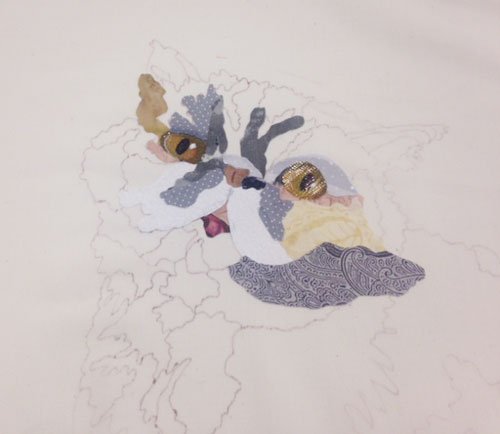
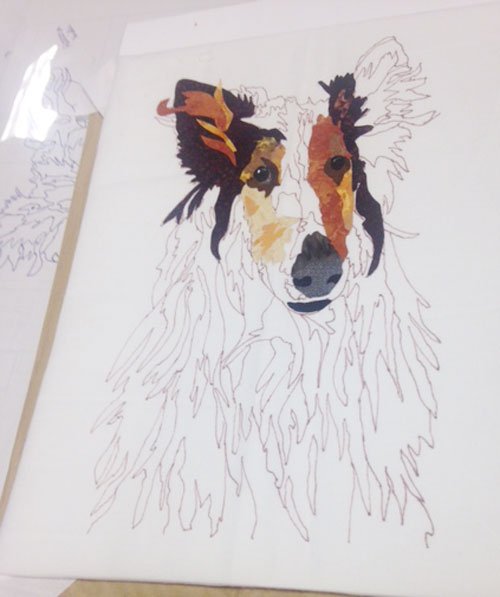
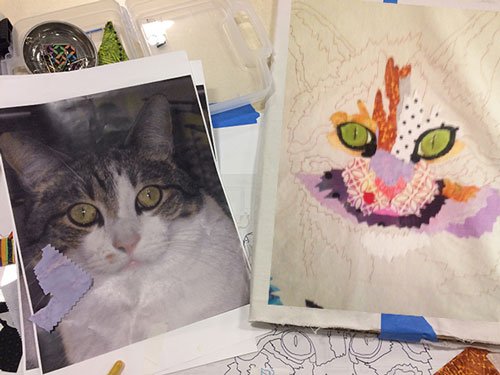
Each student was to bring a picture of either flora or fauna, a photo enlargement, fusible web and a lot of fabric. Her technique was very interesting and the results in just our 6 hour workshop were wonderful!

My friend Evelyn (of Quilt Sissies fame 🙂 ), chose to do a special cat. She was amazed at the amount of blue in the picture – for a cat that wasn’t blue.

Laura decided to portray her cat in unexpected fabrics.

I can’t wait to see some of these finished!

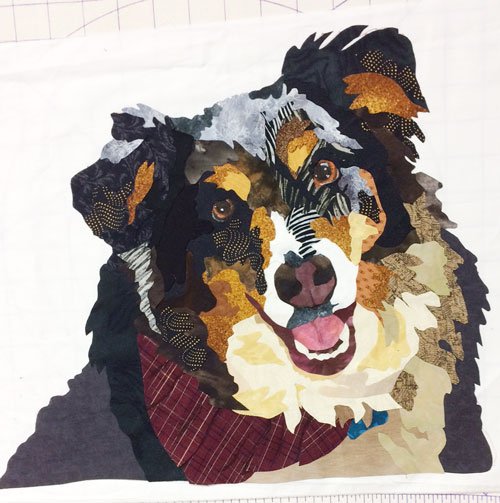
I chose to do our grand-dog, Moseley. He’s a very pretty Australian Shepherd (photo courtesy of my daughter-in-law Betsy).

Here’s my “Moseley in progress”

and here’s Moseley!

Next I need to find the right background. I cut him out and placed him on a number of different fabrics and I’d like your opinion on which to use, or suggestions for other options.

background 1

background 2

background 3

background 4

Please comment in the box at the bottom of this post to vote for your favorite, or offer other suggestions. If you don’t see a comment box, click on “Appliqué Animals” at the top of this post and scroll back down to the bottom.

I love taking classes and learning new techniques. This was a fun class and a great technique. Here’s a challenge to anyone in that class. If you finish your piece and send me a picture, I’ll be thrilled to post it on my blog!

Scarecrow Faces

November 27, 2016 3 Comments

Important information about our upcoming cruise

Our Sew We Go cruise from Quebec to Boston in September of 2017 is going to be norwegian-dawnspectacular! And we still have a few cabins left. Because this is such a popular cruise, most cabins not spoken for by December 26 will be released back to Norwegian Cruise Lines. So, if you’ve been contemplating joining in on the fun, we need to hear from you soon. This could be a wonderful addition to your Christmas “wish list”. For all the details go to: https://www.chrisquilts.net/trips/, or to open a printable pdf click here!”

***And now for my topic of the week***

While teaching in Nebraska last year, I found a pattern for a table runner I just had to have.

topsy-turvy-scarecrow-pattern
To order your own pattern go to: Happy Hollow Designs!

I usually like to design my own projects, but these scarecrows were just too cute, and I promised myself I would make it this year! I pulled it out in the beginning of September only to realize I didn’t really feel like tracing/cutting out all those little pieces. Inspiration struck when I thought about scanning the pattern into my Brother Scan ‘n Cut™, and letting this wonderful machine do the tedious work. It was a great project for me to learn more about what my Scan ‘n Cut™ can do (to read my previous Scan ‘n Cut™ post click here).

Once the pieces were all fused and cut out, Sommer helped me to “build” the scarecrows. She was disappointed when I ironed them down

scarecrows-faceless

and machine blanket stitched around them,

scarecrows-stitching

because she couldn’t keep playing with them. So she offered to draw the faces. I stalled until mommy came to pick her up. That night I told Mike about it and he said I should let her. Duh!

The next day I had her draw some faces on paper first. We talked about different expressions, and shapes for eyes and mouths. I was amazed at how confident she was. Then I handed her a washout marker (grandma loves her, but she’s not crazy 😀 !) and stepped back. Without hesitation she drew every face: boom! boom! boom! She was done and never even needed to turn the piece around to draw the upside down scarecrows!!!


scarecrow faces scarecrow-faces-detail2

And here’s the finished runner:

scarecrow faces

I love them! I traced over Sommer’s lines with permanent marker. I think it’s my favorite table runner ever.

  • Page 1
  • Page 2
  • Go to Next Page »

Primary Sidebar

Archives

Recent Posts

  • London ~ and More
  • Designed For a Purpose
  • Squirrel Quilts and More
  • Vintage Appliquéd Arrows and More
  • Fascinating Tidbits

Recent Comments

  • Karen Ann Moore on London ~ and More
  • Cheryl McLean on London ~ and More
  • Sue Halpern on London ~ and More
  • judy raddatz on London ~ and More
  • Joanne Corrigan on London ~ and More

Categories

Footer

My Guide

Whatever you do, do your work heartily, as for the Lord rather than for men.

—  Colossians 3:23

Contact Chris!

  • Home
  • About
  • Gallery
  • Classes
  • Trips
  • Books
  • Blog
  • Contact
  • Sign Up For My Blog

Copyright © 2026 · Chris Quilts · Website by Adunate · Privacy Policy