• Skip to main content
  • Skip to primary sidebar
  • Skip to footer

  • Home
  • About
  • Gallery
  • Classes
  • Trips
  • Books
  • Blog
  • Contact
  • Sign Up For My Blog

Blog

Easiest No-end Binding ~ Refresher

October 17, 2021 7 Comments

A few years ago I discovered a technique that I think is the easiest way ever for joining the beginning and ending tails on a binding. You don’t need a special ruler, an iron, or math. It’s done with a 2″ piece of Dritz Wash Away Wonder Tape™ (which I now keep next to my machine at all times 😊).

As I was using this technique to bind Josiah’s quilt, the teacher in me knew I had to share it once again; for newer viewers and as a reminder to the rest of you 😃. It’s the only one I’ve used for the past 3 years and I highly recommend it. It’s really this easy:

Leave an opening between your beginning and ending tails about 10″ long:

Fold one tail back to create a 45 degree angle. No math is required because you can check it by putting a square ruler in the inside corner that’s created:

Place a 2″ piece of tape along the fold and rub with your fingernail to be sure it sticks:

Remove the paper from the tape, leaving the glue strip along the crease:

Lay the other tail in place along the edge of the quilt, and over the tape on the crease:

and finger press to secure tape to this second strip:

Lift the strips to reveal the inside of the crease:

Gently pick the entire piece up and stitch in the crease:

Lay the binding back on the quilt to make sure it fits:

Once you’re sure, trim off the tails:

Lay back in place and sew this last portion of the binding to the quilt:

Voila. I just leave the tape in place since it will wash away. Turn the binding to the back of the quilt and finish as usual. I hope you’ll give it a try!

***********************

Correction!

In spite of the fact I like math ~ it was brought to my attention that I have oft repeated a counting error. Doris sent me an email after watching my Quilt as You Go lecture at the Great Wisconsin Quilt show saying that she could only come up with 6 layers when sewing the front and back sashing on, not 7. She’s exactly right and I apologize for any confusion this may have caused. Fortunately the technique remains the same 😊. Thanks Doris, for letting us know!

Accordion Door Quilts

May 30, 2021 2 Comments

Last week Suzanne commented that she’d like to know how I make an accordion door quilt (click here to read that post). I’ve been asked if I would ever teach a class on this technique and my answer is always “I don’t think anyone else is crazy enough to want to make three quilts to get one” 🤣. But I guess there are a few of us out there, so I decided to share the basics now. I did a bit of searching and discovered I had covered this technique briefly once before, but that was back in 2013 – so let’s do it again.

The first time I made an accordion door quilt was back in the late 1990’s. It was made for a contest with the theme “Reflections”. Making hand mirrors with the reflections of the women who were part of my quilting journey seemed like a good idea. These included my great, great grandmother Mary (lower left). She is the only quilter in my family tree. I never met her but I own, and treasure, 2 of her quilts. My mom is in the upper left mirror and she taught me how to sew when I was 7. She is still one of my biggest cheerleaders (Dad’s the other – praise the LORD!) My dear friend Sharon is in the mirror on the lower right. She taught me how to quilt when I was 40 and is still one of my closest friends. And the last mirror is of me. I included interlocking circles to represent the Trinity (since my faith is a huge part of my inspiration as an artist), and I connected them all with a twisting red thread.

This quilt was interesting, but it wasn’t interesting enough to enter into the contest, so I made a second quilt the exact same size. The design began in the lower left corner with log cabin blocks similar to those in one of my grandma Mary’s quilts. These blocks morphed into a variation of my Parallelisms quilts. I felt it represented my earliest quilt inspiration in one corner flowing into my passion at that time, art quilts, on the other.

As you can guess, I had to find a way to put them together and the accordian door quilt was born. I call it “Reflections of My Quilting Heritage”. The base quilt I made to hang the “accordion door” from measures 70″ x 50″ and contains small shisha mirrors which I hand embroidered in place to keep the reflections theme going. It was all put together through the magic of Velcro™.

A few years later I felt the urge to make another one, but smaller. It was inspired by a stack of vintage double wedding ring arcs a friend found at a rummage sale. She gave them to me and I gave one to each of the members of the Milwaukee Art Quilters and asked them to do something creative with it. I began by putting paper backed fusible on the back of my arc and cutting it into skinnier arcs. Then I fused them to a background fabric in a swirling design and quilted concentric circles. The blue lines are where the quilt will be cut.

I pieced and quilted a more traditional intersection of double wedding ring arcs for the second quilt (cutting lines marked here too).

Both quilts were cut on the blue lines and laid out in alternating strips which I zig-zag stitched together with invisible thread, and then bound the entire piece.

On the back I stitched a length of the hook portion of Velcro™ tape along both sides and down every other seam (the grandmothers flower garden on the back is a preprinted cheater fabric). I used white and black Velcro™ because that’s what I had on hand.

On the base quilt I sewed the loop Velcro™ strips.

The Velcro™ strips are then matched up and this is the finished quilt from the left and right:

How Beautiful – Liberty is the third and most recent in my series.

I’m not sure if/when I have another one in me, but if you decide to play around with this crazy technique please send me pictures!

PS If you’d like to see all the other Objet D’Arc quilts in the Milwaukee Art Quilter’s “double wedding ring arc” challenge click here.

A Non-virtual Class

April 18, 2021 4 Comments

Last weekend was an exciting, busy time for me. Friday and Saturday were spent at a Christian Women’s retreat in Green Lake, WI. It wasn’t virtual! We actually got together and had a fantastic time of worship and fellowship. I arrived home Saturday evening spiritually refreshed… and exhausted. I fell into bed early so that I could get up Sunday morning and drive to the Wisconsin Museum of Quilts and Fiber Arts to teach my first “in person” class in a year and a half!!! What a blessing!

In 2019 I was asked to donate a class to be auctioned off at the museum’s fundraiser. Lisa purchased my private workshop and invited 3 of her friends (actually her mom, daughter and a friend) to join her for my Seminole Sampler class. Everything was of course postponed last year, but the museum is beginning to schedule classes and we were the first on the list! What a joy!

The quilt museum has a bright and organized space for classes, and the exhibit space is filled with fascinating works of fiber. It’s open with all the appropriate precautions in place. Cedarburg has many lovely shops and eateries also, and I highly recommend a road trip!

The ladies each completed many wonderful Seminole strips and they now have a “tool box” full of border patterns for future quilts.

Thanks to Lisa, Joy, Tiffany and Cary for a delightful day. And a big thank you to Marilynn too – for being there for the museum and to take care of our needs all day.

*****************

In this week’s post I’d also like to share a follow up to the “Labels in the Binding” post from a few weeks ago. Camille finished her sister Ruth’s quilt and sent me these photos:

Quilt front – quilted and bound
Quilt #2 on the back

and here’s the label!

This is a portion of Camille’s email to me that accompanied these photos:

“Hi Chris, Thank you for mentioning my sister Ruth’s quilt and words on the binding project on your recent blog! She was surprised and pleased to see your article… I will definitely do words on the binding again. This was truly a learning experience. I always enjoy your blog topics. Camille”

Thanks Camille, I’m so glad we were able to see the finished quilt. I’m sure Ruth LOVED it!

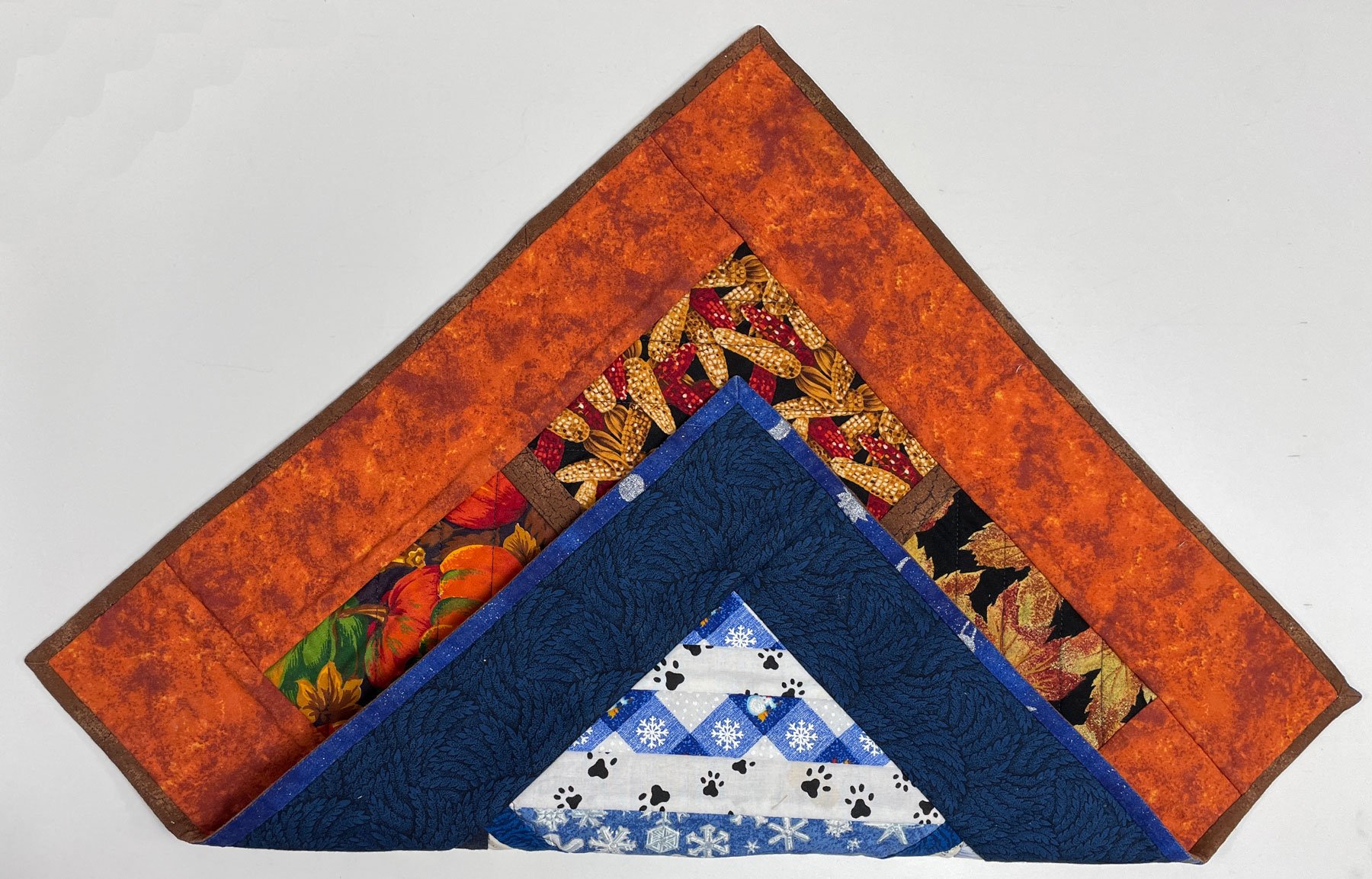
Two Sided Binding

April 11, 2021 7 Comments

I came up with this method years ago when I made a small reversible table topper. There was no binding color that would look good on both sides since they represented two different seasons.

So I played around a bit and discovered a way that’s really quite easy to do! I find it works best done as a single binding.

Determine the width of the finished binding, multiply by 2 and add ¼” (ie. a ½” finished binding would be ½” x 2 = 1”; and 1” + ¼” = 1 ¼”). Choose a fabric to match each side of the quilt and cut enough strips from each (selvedge to selvedge) the above measurement in width, to go around the outer edge of the quilt. Sew all of the matching strips end to end to make a length of binding for both the front and back fabric.

Stitch these 2 long strips to each other with a 1/4″ seam allowance and press it open.

Now fold the binding in half and press again. By pressing the seam twice a sharp fold will result.

Lay the appropriate binding strip, right-sides-together and raw edges even, with one side of the quilt. Stitch in place (leaving a tail for a no-end finish). Use your binding width measurement as the seam allowance (mine was 1/2″). The distance from the edge of the quilt to the line of stitching should be equal to the distance between the two seams (note arrows below).

At the corner stop stitching at a spot a seam allowance away from the next edge of the quilt (for a tutorial on this click here). Fold the strip up at a 45 degree angle and then back down against the next edge, and continue to stitch in place.

Attach the binding all the way around.

There is nothing tricky about turning this binding to the back. Simply bring the binding around to the back (it will naturally cup at the corners),

and place the raw edge of the binding even with the raw edge of the quilt.

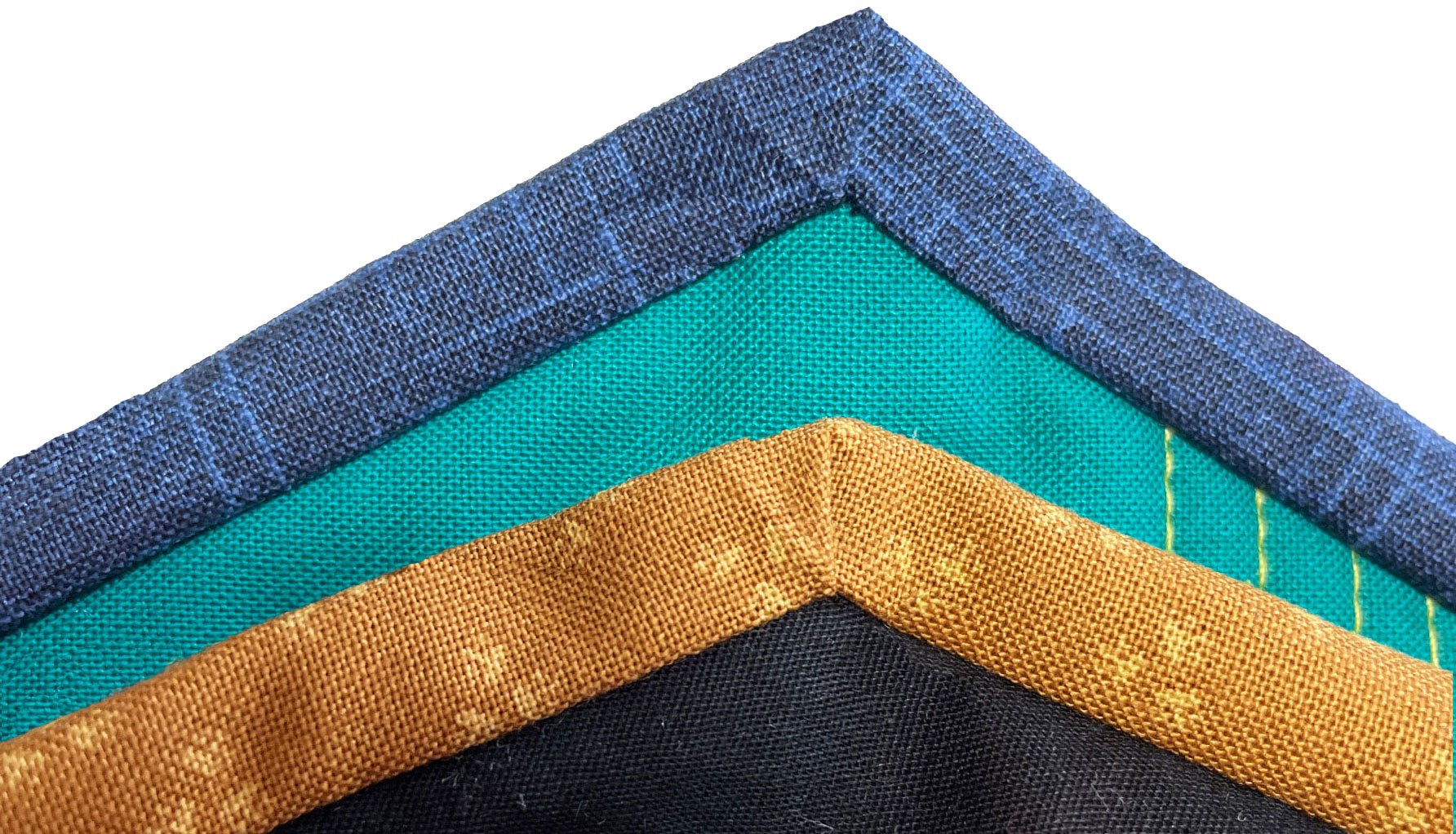
Fold it over flat against the quilt (the seam should lay at the outer edge of the quilt). This will create an angled corner (similar to wrapping a gift):

Carefully fold the adjacent binding over the edge of the quilt and pin/clip in place:

I like to hand-stitch the binding in place to finish – and it looks great front and back!

I hope you’ll add this technique to your “bag of tricks”. Over the years I’ve posted many tutorials on different techniques. If you ever want to find one from the past, simply type the topic into the search box on this site. If you have trouble locating what you’re looking for – please don’t hesitate to send me an email 😊. Enjoy!

********************

This week’s bonus! Jodi sent me this email:

“I had taken your class at Expo a couple years ago, and have been waiting to use it. Did a simple layer cake quilt for a friend because we both love this fabric. Decided to try the Seminole on it. Took me 2 days of piecing, but I’m LOVING it! Thank you for the inspiration!”

By cutting every other strip narrower, the size of the chain of squares down the center alternates and is more interesting. Great job Jodi – please send a photo of the completed quilt!

Labels in the Binding

April 4, 2021 4 Comments

I am a firm believer in the value of putting labels on our quilts. They may not be around forever, but then again they might, and with a label the story of the quilt lives on with it. Writing your name and the date on the back is an easy option. The other end of the scale is to hand-write the entire story of the quilt on a seperate piece of fabric and stitch it on.

But there are many other options somewhere in between. I often print my labels using the computer as I did for this Replique quilt I made for my first book:

When creating labels on the computer photos can be added:

A label can also be embellished in many ways, such as the one for this scarecrow runner I made with my granddaughter’s help:

She helped with the label too!

I wrote a post a few years back on a trick for attaching a label.

Click here for that link

Then there was the post where I simply tucked a folded corner label into the binding.

To link to that post click here! 

Recently Camille contacted me with a quilt question – and then shared a great technique! I’m sure many of you will find this interesting.

“Hi Chris, I am making a quilt for my sister. She insisted that she wanted 2 quilts, but not separate entities. She wanted one quilt design on the front and another on the back. On one side, she chose a double Irish Chain pattern using spring/summer fabrics. On the other side, there is a more modern design using winter/snow fabrics. Her idea has me flummoxed about a label. A traditional label would spoil the effect of either side. Images are included below.

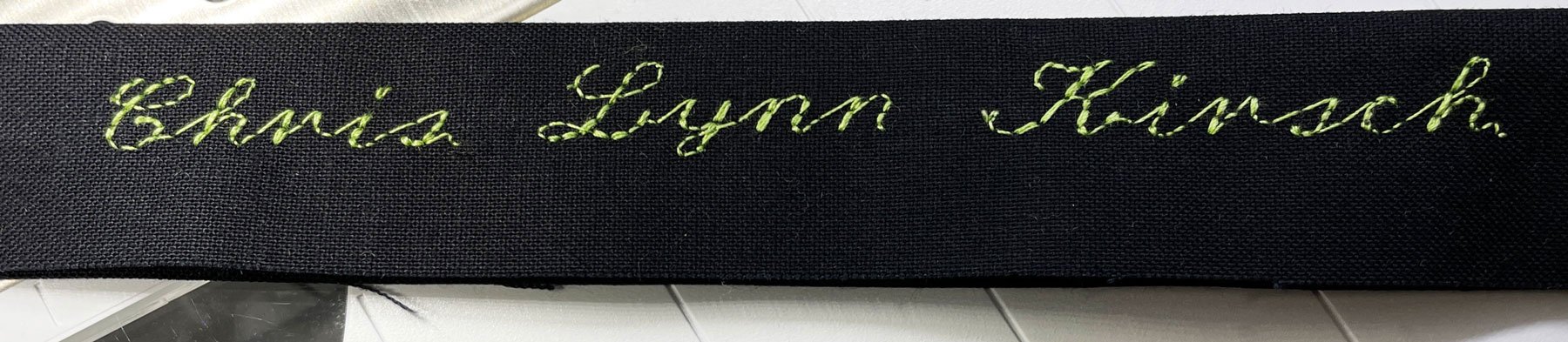
Many years ago (when I could not imagine I would ever consider the technique) I saw an article about label information being machine embroidered along the length of the binding fabric. The embroidery was done with a thread that matched the fabric closely to produce a discreet but effective label. This would work perfectly to document this quilt without interfering with either of the quilt designs.

I thought you might have written about this but a search did not reveal what I am thinking about. I have not found it with web searches either. Have you run across this idea?”

Before I could respond Camille sent me this:

“Yippee! I found a binding technique similar to what I was looking for!
https://weallsew.com/quilt-binding-words/“

These instructions are on a blog from Bernina and they look very well done. I tried a sample for myself and had a great time learning how to use the alphabets on my new machine.

Now to make a quilt that I can use this technique on. Thanks so much Camille!

Have you created a label in a binding? What was your technique?

Camille’s two sided quilt gave me an idea for another post. Next week – Two Sided Binding for a two sided quilt!

*****************************

Wishing each of you a blessed Resurrection Sunday!

Risen by Chris Lynn Kirsch, 2014

Binding Odd Angles

February 14, 2021 7 Comments

I few weeks ago Lynn emailed me and asked:

“Do you have a favorite way of binding an hexie quilt?”

As usual – I do 🤣. In reading over her question I realized there are at least two things that come to mind when I think of a hexie quilt. One would be a quilt made up of many hexagons, like this antique Grandmother’s Flower Garden quilt from my husband’s side of the family:

Since these hexagons are only 1 1/2″ in size, binding this quilt would be a real pain. Whoever made it must have agreed and instead she stitched it to the backing all the way around and turned it right-side-out, envelope style. It was quilted after the layers were put together. This is how I finished my Christmas table toppers this year too:

The other possibility is to bind around the edges as I did on my Octabulous Star quilt:

Now I know that an octagon is different from a hexagon, but my binding technique works equally well for both. This quilt is 40″ wide and I bound it with the orange floral fabric. The corners on either shape are greater than 90 degrees (obtuse) and I bind the corners in the same way I do a square or rectangular quilt. Here are the diagrams from my binding handout for a 90 degree corner:

Use your desired binding width as your seam allowance (ie. 1/2″). Stop and backstitch this distance from the next corner.
Fold the binding strip up at a 45 degree angle. The raw edge of the binding will create a straight line with the next edge to be bound.
Fold binding strip down over quilt, and continue stitching.

And that’s it. So how do we adjust for odd obtuse angles? Let’s do the octagon first. I use a single binding, but this technique works just as well for a double (French) binding.

Stitch the binding to the squared up quilt. Be sure your seam allowance is the same as the width you’d like your finished binding to be (mine is 3/8″). I’ll be ending the stitching line 3/8″ from both edges at the corner, and I have an easy way to determine where that spot is!

Stop stitching about 3″ from the corner, fold back the binding strip exactly at the corner of your quilt, with the strip completing a straight line with the next edge of the quilt to be bound (the ruler is there to show the continuation of the edge). Crease this fold with your fingernail.

This crease will be exactly on top of the corner of the quilt:

Lay the binding strip back in place and sew to the crease, ending with a backstitch. Remove from machine.

Fold the binding back over the crease,

then fold it down through the corner,

laying the edge of the binding along the new edge to be bound. This creates the perfect angle without any measuring.

Begin sewing near the crease, and continue down this new edge. Repeat around entire quilt.

To turn the binding to the back, bring the entire binding around to the back of the quilt. It will want to “cup” at the corners. Choose a corner and fold the raw edge of the binding strip even with the raw edge of the quilt.

Next fold the portion on the left down tight around the quilt edge and flat against the back (a double binding strip will already have the fold and needs only to be folded down over the previous stitching).

Fold the next side over the edge of the quilt, gift wrap style, adjusting the crease to fit from point to inside corner. You may have to fiddle a bit to get it to lay correctly. It’s worth trying a few times to get it right.

Pin.

And this is how it looks on the front:

Hand-stitch binding in place around entire quilt.

Binding a hexagon is the same technique and, because we didn’t have to do any measuring, the angle may be different but it doesn’t matter.

Stitch the binding strip to the quilt, fold the angle, and crease as before:

Backstitch and remove from machine:

Fold binding strip back along previous crease, and then in place along the next edge as with the octagon binding, and continue:

The turning to the back is done as with the octagon also. And here are the pinned corners of both angles:

There is a search box on my site to locate these tutorials whenever you actually need them, or they can be printed from a computer by simply clicking on “File” at the top of the screen, then “Print”, and follow the prompts.

Quilting a King

November 29, 2020 16 Comments

As I begin to compose this post my scrappy diamond quilt top is complete and it’s ready for quilting. In the past I’ve quilted 2 king sized quilts on a domestic home sewing machine. Now that I have a HQ Sweet Sixteen mid-arm, I think it will be much more enjoyable 😁. Please join me on my “quilting a king” journey.

The first step: pin baste the quilt in a frame (in my husband’s shed).

In previous posts I’ve shared how to use this simple frame learned from my quilting teacher, Sharon Grieve Grinyer, way back in the late 80s. It requires four 10′ long 2″ x 2″ boards, four bar clamps, and four high back chairs to set it on. I first shared this step-by-step technique for basting in 2011 and, since many of you weren’t following my blog back then, you are welcome to click here to link to it!

Once the quilt is in the frame I safety pin the layers together and it’s ready for quilting.

But what design to use? I typically like to begin by straight line quilting in some sort of grid to hold everything together, and get rid of a lot of pins. Since I greatly dislike stitching in the ditch I like to look for other options. Eureka! The pattern for these blocks did away with this problem! Because the edges of the first two strips sewn to each foundation were aligned with the diagonal of the block, the seam was 1/4″ away from it. This allowed me to straight-line quilt the long diagonals, without being in the ditch! I did this part on my regular machine (I find long straight lines turn out better with feed dogs).

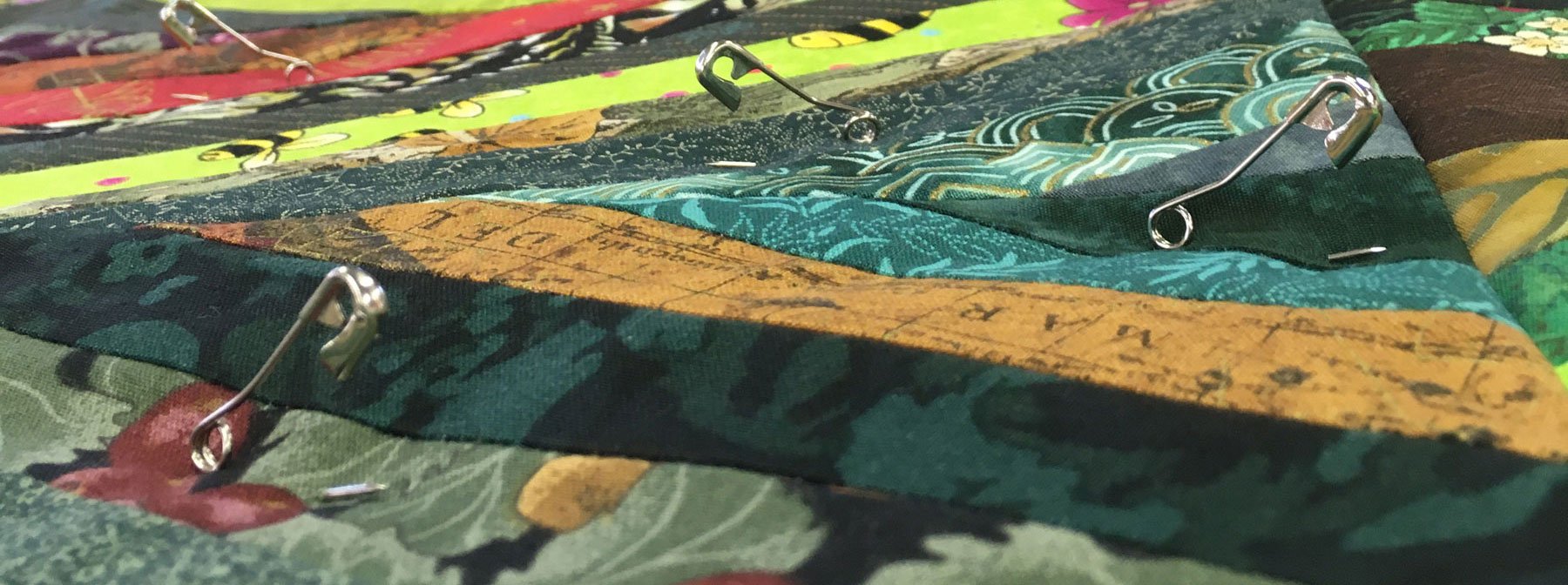
This next part I’ve shared before, but I feel it’s worth repeating: quilting long lines with the feed dogs up often causes puckers on the back of the quilt. My solution is what I call my 3 pin technique. I put the needle down at the start of my quilting line and place 3 pins perpendicular to the seam I’m about to sew.

I remove the pins as I stitch up to them, then repin the next portion. It may sound a bit tedious, but once I establish a rhythm, it’s a breeze and it results in no puckers!

After the quilt was gridded along the large diamonds, I moved to my mid-arm. Since this quilt is so scrappy, fancy free-motion quilting would probably not show, so I did what I often do – I asked myself “what would be fun?” The answer – ruler work!

Straight line quilting in all directions on a large quilt is extremely difficult on a domestic machine, since the quilt needs to be rotated through the small opening under the arm of the machine. By dropping the feed dogs and using rulers that problem is eliminated. It works especially well with the channel ruler from Four Paws Quilting. I set the ruler along the line I wish to quilt and, since it’s free-motion, I simply push the quilt and ruler along at an even rate as I stitch (don’t my colorful gloves get lost in the busy patchwork?).

When I get to a pivot point, the ruler is rotated without turning the quilt, and the process continues.

I’m very pleased with the two concentric diamonds I’ve sewn inside each gridded diamond (you’ll probably have to zoom in to see them) – and I’m truly enjoying every step of the process.

As I mentioned before, the quilt is so busy the quilting doesn’t show from the front. It’s easier to see the concentric diamonds from the back:

And last night we slept under it!!!

I’m very pleased with the results and Mike likes it too!

*************************

One last thing – Lynn just sent me a photo of a string quilt she made and I couldn’t resist sharing it with you.

I’m really loving these scrappy quilts. Thanks Lynn!

Spicing Up Our Quilts

November 22, 2020 4 Comments

Donna sent me the photo of her Lake Michigan quilt during the time I was posting about being inspired by the colors of nature. This is what she said:

“Here’s a quilt that I made inspired by Lake Michigan. Every time I looked at the lake there were all kinds of marvelous colors which always changed with the time of day or the season. I’d say to myself, I have fabric that color! (My favorite color is blue, go figure)
It’s called ‘Ode to the Many Colors of Lake Michigan’.”

What a spectacular work of art! I love the glow in the center. She then sent me a second email in which she mentioned an inner “border” she appliquéd on, just because the quilt needed it:

“Between the lady of the lake blocks and the outer border there is a 1/4 inch stripe fabric appliqued on. It kind of needed that definition, though I didn’t want to do it. Once done it was a nice addition.”

Donna admitted that appliquéing that narrow striped border was worth it, and I really admire the effort it took. What an effective addition!

I’ve had a few occasions in my quilting life when the quilt was done, but it just needed a little something more. One of them was “Pekoe and Cut Black”, a quilt I made for a “Tea” challenge. I decided to pull a bunch of white/cream scraps from my stash and dye them in tea. I only used these fabrics in the quilt, including the binding. So the outer edge ended up looking quite bland.

To add definition I couched a piece of variegated yarn in the ditch between the binding and the quilt and I was much happier with the results:

And here’s a detail shot:

Another quilt which benefitted from couching a “piping” along the binding was one I made with my friend Sharon Rotz. We made it for the New Quilts From an Old Favorite challenge at the National Quilt Museum in Paducah. The “Old Favorite” was the monkey wrench pattern and our quilt is entitled: Two Friends Monkeying Around:

It was accepted into the competition, hung in the museum during Quilt Week, and traveled with the exhibit for 2 years before we got it back. At that point Sharon decided to enter it in an art competition. She felt the edge needed a bit of definition and couched black cording along the binding.

This addition framed the quilt well and we took first place! Here’s a detail shot:

I think these “spicing up” additions we’re well worth the effort in each of the above quilts. Have you ever added a little extra zip to a quilt in this way? If so, please send me photos!

Bonus Story

Many of you have heard the story of my Tea quilt, but in case you missed it – enjoy 😊:

I drew a number of swirls originating from a center circle until I found the one that was just right. I then stitched them together using Caryl Bryer Fallert’s applipiecing technique. I quilted each area with a different free-motion quilting pattern, adjusting the design when it hit my pre-marked circle.

This quilt is part of my “Crossings” series where portions of the quilt are made separately and then the pieces are connected back together with beads. It’s a spiritual journey series of quilts in which I feel the beads cross the gap and hold the broken pieces of my quilt together as my faith in Jesus Christ holds the broken pieces of my life together.

In most of the quilts in this series I bead together rectangles or squares. This time I decided to make the entire quilt – quilted, bound and finished. Then I cut the circle out of the center of the quilt, finished both edges with corded piping, and beaded the circle back into the hole it had created with pyramid beads from a broken bracelet. It was quite a gutsy move, but I was pleased with the results.

For some reason I feel like making myself a cup of tea right now 😁.

Wishing you all a blessed Thanksgiving!

  • Page 1
  • Page 2
  • Page 3
  • Interim pages omitted …
  • Page 5
  • Go to Next Page »

Primary Sidebar

Archives

Recent Posts

  • Spring Thaw
  • Quilting in Bloomington ~ Part 2
  • The Indiana Heritage Quilt Show ~ 2026
  • Bird’s Eye View
  • The Birds

Recent Comments

  • marlene on Spring Thaw
  • clkquilt on Spring Thaw
  • Mary Alice Hart on Spring Thaw
  • clkquilt on Spring Thaw
  • judy raddatz on Spring Thaw

Categories

Footer

My Guide

Whatever you do, do your work heartily, as for the Lord rather than for men.

—  Colossians 3:23

Contact Chris!

  • Home
  • About
  • Gallery
  • Classes
  • Trips
  • Books
  • Blog
  • Contact
  • Sign Up For My Blog

Copyright © 2026 · Chris Quilts · Website by Adunate · Privacy Policy