• Skip to main content
  • Skip to primary sidebar
  • Skip to footer

  • Home
  • About
  • Gallery
  • Classes
  • Trips
  • Books
  • Blog
  • Contact
  • Sign Up For My Blog

Blog

Completing a Quilt-as-You-Go Tree Skirt

June 14, 2020 3 Comments

Now that my compass stars are attached to the background wedges with piping, it’s time to layer each wedge and quilt it. I stitched in the ditch down the centers of the compass star points, echoed around the compasses, and filled the green background in with free-motion holly leaves and berries.

Next I grabbed the pattern, laid it on a wedge, and trimmed each wedge to size (the Olfa™ pattern weights saved me from a lot of pinning).

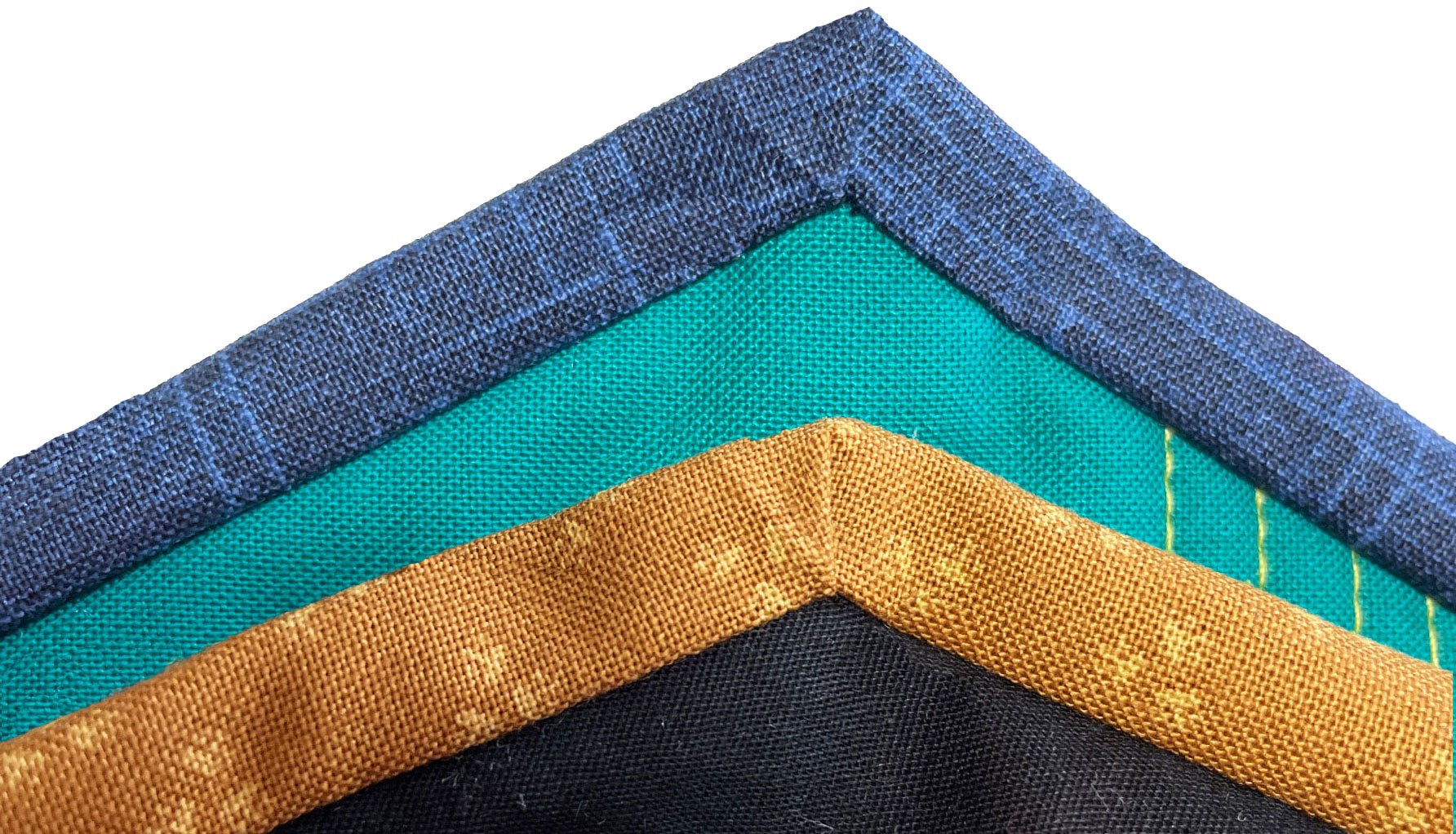
I put the wedges together with contrasting fabric, and the reversible quilt-as-you-go technique I’ve written about in previous posts (click here for the technique). Then I bound all the way around with bias binding in the green fabric. I used red bias binding to finish the opening and the center “hole”.

At this point I felt it needed a bit more color and spark, so I made five turned and quilted squares (they look a little like pot holders),

I added them between the outer scallops, stitching them in place in the ditch along the green binding.

Here’s a back view, with the top corner of the square hand-tacked in place:

And it’s done! In plenty of time for Christmas!

I hope some of the techniques I shared in this project will be helpful to you!

Appliquéing a Circle with Corded Piping

June 7, 2020 6 Comments

For quite a while now I’ve been telling the students in my Mariner’s Compass workshops that I would do a blog tutorial on a fun technique for using corded piping to attach circles to a background. Once I made my 60 degree compasses – I knew it was time!

To begin you’ll need 1 1/4″ bias strips – last week’s post should be helpful concerning this – click here if you’d like to access it again.

You’ll also need cording to fill the piping. Cordings like this are sold at your local craft store in a variety of sizes. People also use yarn, drapery gimp, perle cotton, etc.. It all depends on the size you want your corded piping to be. For this project I used rayon rattail because I had a bunch leftover from a previous art quilt challenge and it was just the right size (it’s being red, like the cording I was making, was a happy coincidence).

Corded piping can be made using a piping or zipper foot for your machine. I find that the zipper foot can be a bit squirrely, and many machines don’t come with a piping foot. For this project I grabbed the buttonhole foot that came with my old Bernina (foot #3). It worked like a charm.

My cording was just the right size to fit into the groove on the left. I folded the bias strip in half and inserted the cording into the crease. Then I placed it under my machine and adjusted my needle to stitch snuggly against the cording.

With the needle down I ran my thumbnail along the cording to make a nice crease (a great tip I learned from Ricky Timms), And gently continued to crease the fabric as I sewed:

Once I had made enough corded piping for my needs, it was time to trim. I absolutely love Susan Cleveland’s “Grooving Piping Trimming Tool”. It will trim a 1/4″ or 1/2″ seam allowance almost effortlessly.

The corded portion fits into the groove on the bottom of the tool, the excess fabric is trimmed with a rotary cutter, then the strip is simply pulled under the tool to trim the next portion – quick and easy!

Since I had six circles to pipe, I need a lot of piping:

When the piecing of my compasses was complete, I trimmed the seam allowance around the outer edge to 1/4″:

I removed the first 1 1/2″ of stitching on the corded piping and placed it, raw edges even, along the right side of the compass. I made sure my beginning/ending join wouldn’t be on top of a seam. I began stitching 1 1/2″ from the end of the piping, leaving the end free for the joining step, and sewed it on with the same foot to keep everything in place. You’ll be sewing on top of the previous stitching.

When I reached the start, I stopped stitching 2″ from the beginning stitches, cut the piping 1″ past the end of the beginning tail, and removed 1 1/2″ of the corded piping stitching to expose the cording, as I did with the beginning tail.

Next I laid both ends in place so I could trim the cording ends to butt up with one another (be careful not to snip the fabric when you do this – ask me how I know ?).

Fold in a 1/4″ hem on the beginning tail.

Lay the bias strip against the circle, place the ending bias strip evenly on top of it, and allow the cording ends to meet (butt).

Fold the strips in place and pin.

Finish stitching the piping to the circle.

Fold the seam allowance to the back of the circle so the corded portion sits at the outer edge.

Pin the circle onto a background fabric and stitch in the ditch between the circle and the piping to attach it. I used the same foot for this step too.

And it’s done!

At this point I cut away the background fabric from behind, 1/4″ from the stitching to expose the paper pieced pattern, and removed all the paper.

There are so many great advantages to this technique: no hand-stitching needed, it works with any circle or other gently curving shape, and it adds a spectacular effect!

Next week I’ll share how I put the wedges together and finished the project!

Cutting Bias Strips

May 31, 2020 5 Comments

Last week I did a “show and tell” about my new Compass Star tree skirt. Both the piping that attaches the stars to the background, and the binding we’re made with bias strips. I have a favorite way to cut bias strips and I can’t believe I haven’t shared it before.

When I learned to sew, way back in the 70’s, the common way to make a long strip of bias was to cut a rectangle of fabric, mark parallel lines the width of the desired strips, sew the short ends together, offsetting the marked lines by one, and then hand-cut on the line all the way around.

It made a lot of bias, but sections of the length had oodles of seams, some quite close together. I never cared for that. So here’s my technique:

Open the yardage on the work surface, with the selvedges top and bottom . Lay the 45° line of a long ruler parallel to the selvedge at the bottom,

and with the long edge of the ruler in a place that will allow a nice long length of bias.

As you can see my ruler wasn’t long enough to complete the strip, but it was quite simple to cut half way up and then slide the ruler to cut the remainder.

I set aside the lower triangle, and folded the bottom selvedge edge towards the upper left:

until the freshly cut edge lies on top of itself:

Then I determined my strip width and aligned that line of my ruler with the cut edge, being sure to cut perpendicular to the fold at the bottom (my strips will be cut at 1 3/4″),

Cut as many strips as needed in this way.

Here they are unfolded. You’ll notice that the ends are all at 45 degrees when using this technique.

To join the strips: place one, right side up on the work surface, and position the second strip, right sides together and perpendicular as in the photo (I think of it as a right angle “7”), overlapping to form 1/4″ dog ears.

Stitch from the corner of one dog ear to the same spot on the other end.

Then press flat.

I like to chain stitch all the diagonal seams until the strips are all connected.

That’s all there is to it. In next week’s post I’ll demonstrate how to make corded piping from bias strips and use it to “appliqué” my compass stars to the background.

12 Pointed Mariner’s Compass Stars

May 24, 2020 9 Comments

A few weeks ago I posted about what I was stitching on during our time of isolation. One of the projects I shared was a twist on my Mariner’s Compass technique inspired by my friend Mary Ellen. I made three of these compass stars while on retreat in the beginning of March:

Then I made 3 more while I was “safer at home”:

The drafting is almost identical to the technique I use in my Compass Capers book (click here to purchase a copy).

Compass Capers, by Chris Lynn Kirsch

I begin with a circle of paper, but this time I fold it into sixths instead of the traditional eighths. Then, as in the book, a few marks are made, and I connect the dots! Here’s an example:

By connecting the dots in different ways, many different stars can me made as is evidenced in the 6 compass stars above. I then cut them into wedges and paper piece them.

Once my compass stars were made I decided they would be beautiful in a tree skirt (our current skirt is 44 years old and has seen better days). To do this I taped together newsprint until it was a good size for a tree skirt. I folded this large piece into sixths, laid a compass star at the outer edge of the paper and drew an arc to fit. These 6 wedges were cut apart and I was ready to cut my background fabric, batting and backing.

I decided to use a “quilt-as-you-go” technique for putting the skirt together. This meant I could layer and quilt each wedge individually which made things much easier. And this is the finished tree skirt (I know it’s not a Christmas tree but, c’mon, it’s May 😄):

I used a number of different techniques while putting this project together and I’ve decided to do tutorials on them in the next few posts. Stay tuned 😊!

Mending With Boro

May 17, 2020 2 Comments

It turns out I have one more “Japan trip” post in me. It’s actually about the origin of sashiko – which began as a type of mending – and I hope you find it interesting.

While in Japan I enjoyed wearing the jacket I made with my friend Evelyn prior to the trip.

When I returned home, after washing the jacket, I discovered a tear along the bottom edge of the lining (I must have caught it on something).

I could easily have patched it and nobody would have been the wiser, since it was on the inside of the jacket. But I’ve been fascinated by “Boro” mending ever since learning about it in Japan, and I thought it would be fun to give it a try. For a site with the history on this ancient utilitarian technique and how it grew into the sashiko stitching we know today click here.

I bought this lapel pin while on my trip to Japan and was told it was an actual piece of vintage boro.

So I cut a rectangle of blue fabric, stitched and turned it so there were no raw edges (not typically done in boro, but I just couldn’t help myself):

Pinned it in place.

Chose a thread and began to stitch!

Because of the thickness of the fabrics, I had to do a stab stitch, but I think it adds to the effect and I’m loving the results (bottom center on the back of the jacket).

Wow! A way to mend that’s fun! Then, a few weeks after mending my jacket I had another “boro” style mending adventure. This past February I went to a wonderful reunion in Florida with a group of my cousins (before everything was shut down). Deb, Kathy and I found a shop with fun clothing and we all purchased similar shirts.

Mine has been worn and washed a number of times, and the last time I noticed a 1″ hole on the right front. I have no idea how it got there, but something had to be done. Since it was a t-shirt knit I decided to add lightweight fusible interfacing on the inside and then I blanket stitch appliquéd a leaf on the front, and added stitching similar to the shirt embellishment.

I’m rather pleased with the way it turned out.

This might just cause me to like mending. Have you done any creative mending? It takes a bit of imagination, but I recommend you give it a try!

Face Mask and Surgical Cap Update

We would like to thank everyone who has helped with our Mask and Cap project over the past 2 months. To visit our updated site and read the latest news click here.

Gina has compiled a list of all of the hospitals and organizations who have benefitted from your generosity these past 2 months. Click here to read this very exciting list!

Raw-edged Repliqué

May 10, 2020 Leave a Comment

Happy Mothers Day to anyone who is a mom or has/had a mom ?! I had a lovely lunch today with my Mom, and I’m very blessed to still have both of my parents healthy, active and in in my life!

Recently, at the end of a post, I shared a photo of a quilt I gave to my son’s family after the passing of their dog Moseley.

I started that quilt in a workshop with Barbara Beasley. Her quilts are amazing and her technique is very interesting. To read my post about that class click here.

I have to admit that I found using fusible in a “jigsaw puzzle” fashion, with all of it’s reversing and cutting, a bit tedious. So, it wasn’t really my thing. But… Brad, Betsy, Sommer and Trey have another dog who is also 13 years old, and I felt this time of being “safe at home” would be a good opportunity to make a quilt of Nershi too. I decided to create this quilt with my raw-edged repliqué technique because it doesn’t require fusibles and pre-cutting. Click here to read a tutorial I did on this technique last year!

I found a good photo of her – but something was missing:

With Nershi it is all about the ball. As soon as you sit down in their home a ball is dropped in your lap, in the hopes that it will be thrown – over and over again. So I found an image on the web that would work:

I enlarged the photo of Nershi, inserted the image of the ball, and printed it out. Years ago I discovered a way to do this using MS Excel on my computer – Once the directions are completed and print is clicked, all of the portions print out, ready to be taped together. To visit that post and learn how to print enlarged photos from your computer click here and scroll past the Irish chain quilt.

So I taped the enlarged photograph together, placed it on a light box, and traced all of the different shapes and areas to the back of the enlargement.

This step is a bit tedious, but I rather enjoy it. I then chose my fabrics and determined which ones go where by referring to the original photograph. The first part I do is the eyes, using white paint for the sparkle. I stitched the darkest fabric on next using my repliqué technique, but skipping the satin stitching step. As I add each area, I color it in on the pattern. Here it is from the front with the eyes and black fabric added:

I continued adding fabric from darkest to lightest in this way until the dog and ball were done. Then I cut her out from the paper and pinned her to the background fabrics. To add the shadow under Nershi I saved that portion of the paper pattern, taped it in place on the back of the grass fabric, and raw-edged repliquéd the shadow with black tulle.

Next I free-motion stitched Nershi to the background all the way around, cut the background away from behind her, and removed the paper.

The raw-edged repliqué was complete!

It was time to add borders, batting and backing, and to have fun free-motion quilting!

She was done in time to gift to my family for Easter!

I do prefer this method for creating animal portraits in fabric, but now I’m ready to move on to something completely different. Maybe it’s time for some piecing ?.

******************

Hankies – the topic that continues to make us smile!

This past week Margaret sent me another “hankie email”. I’m really loving the responses to that post! I think you’ll enjoy the clever memory boxes she made:

“About 15 years ago, my mother came up with this idea to give to each of
her (4) grandchildren, so I made it happen.  Each memory box contained
one of her hankies & a pair of earrings, one of my dad’s ties with a tie
clip, a copy of their wedding invitation (1944), and a copy of our
family picture (1964).
“

Beautiful! Thanks Margaret!

Then my friend Maureen also sent me a photo of a favorite hankie from her collection, since she was born in Wales, and a book she owns with many ideas for using hankies.

I did an internet search and was able to find copies of this book available for sale.

I asked her about being born in Wales and she responded:

“My mother was a War bride from Neath, Wales. My father was a cook and truck driver serving in England.  I don’t know how they met but my mother told me they dated only three months when he proposed to her!  When my father returned to South Dakota after the war (1946) my mother came to America with me on a boat with other war brides. The captain of the boat woke them up in the middle of the night so they could see the Statue of Liberty as they arrived in New York. We rode a train to South Dakota.”

What an interesting story. Thanks for sharing Maureen!

What are You Stitching?

April 26, 2020 2 Comments

While many of us are homebound, we are fortunate to have more time to quilt and – stashes to work from! Who knew how truly wonderful our stashes were. We don’t ever need to feel guilty about them again ?!

I know that many of you have been making masks for our heroes on the front lines of this pandemic. The face mask project I was blessed to be a part of has collected and distributed over 4300 masks thanks to so many of you. We have recently been made aware of a shortage of scrub caps and are now accepting them also. For a simple video pattern please click here and visit our site. Also, if you or someone you know wears an elastic mask and it’s bothersome to your ears, please read on – I’ve discovered a simple “face mask wearing hack” and I’m sharing it at the end of this post.

Besides making masks (and doing jigsaw puzzles), I’ve been working on a number of other projects. After receiving an email from Betty – I decided on this week’s theme. This was her image and message:

“Chris you’ve inspired me! I have sunbonnet sue blocks that my mother embroidered and hankies that I took when we went through everything after she passed away 3+ years ago. Your posts about the hankies led me to put them together. I will even back them with a thin bed cover that my grandmother had. It will be priceless to me. My question for you is, how do I emphasize the embroidered parts with quilting? I feel like the dainty sunbonnet sues are lost in the rest of the color, even though I love the colors and hankies.  I have attached a photo of the blocks on my design wall.”

What a joy to be a small part of this delightful memory quilt! It was fun coming up with quilting ideas and this was my response:

“When quilting the quilt it might help to emphasize the Sunbonnet Sues by echo quilting around them. This would be easiest to do free-motion by machine or by hand. The heavy quilting will cause them to come forward while the background goes back. This echoing could fill the entire block, causing the hankies to “go back” too. If you prefer straight line machine quilting, The outside edge of each block could be “echoed” inward, avoiding quilting through each Sue, to again cause her to pop.

After sending these suggestions I had another, so I emailed her once more:

“If you quilted “columns” of a design (perhaps a cable) vertically through the hankie triangles, leaving the Sue columns unquilted, that could make the Sues stand out, and add interest to the quilt.”

Then I put the photo she sent me into Photoshop™, added the column lines, and filled them in with a design I found in the computer program, to help visualize this idea. I’m aware this design is ugly and not what Betty would quilt, but quilting in those strips with a cable or filler design might work well.

Betty told me she’d let me know what she decides, and I’ll be sure to share it with you..

So here are some of the projects I’ve been working on:

While on our Sew We Go cruise from Quebec to Boston I purchased pre-cut wool circles (known as “pennies”), a piece of black background, and matching perle cotton in Cape Breton, Nova Scotia. I had no idea what I would do with them.

I began blanket stitching some of the small circles atop the larger ones after the trip. Then I put them in a pretty little bag and haven’t thought about them since. At the beginning of our time of isolation I pulled them out, decided on a nice arrangement, and created a candle mat.

It’s backed with a homespun plaid (once again – hooray for the stash!) – and I love it!

Another project that I’ve been actively working on was inspired by my trip to Japan. There were quite a few quilts in the International Quilt Festival that had intricately pieced backgrounds mainly in blue, and I found them very intriguing. Here are a few examples:

In February I started creating my own blue background for a future Japan memory quilt. I even inserted the sashiko sample I had stitched before the trip. It used up a lot of the dark blues in my stash, and I threw a bunch of other bits in there for fun.

My plan was to take the pieces I made in our classes in Japan, along with a few of my purchases while there, and scatter them over this background. It was great fun to figure out how to add all those special pieces to the top and I now have it complete and ready for quilting, but I can’t share it yet. I hope you’re curious and I apologize for teasing you in this way, but I added three elements to the quilt top to make it acceptable for a challenge being held by my Fiberistas group. These quilts are not supposed to be “revealed” until May, so I can’t show it until then. Stay tuned – I think it will be worth it ?.

Once that top was done I didn’t feel ready to quilt it (has that ever happened to you?), so I looked through my pile of UFOs and found some pieces I had been working on at my guild’s retreat in March (the weekend before the big shut down). These blocks were inspired by my friend Mary Ellen. Mary Ellen used to live in Wisconsin, but now resides in Indiana. A few years ago she invited me to teach for her guild there. One of the classes I taught was Mariner’s Compass. She had taken that class previously and showed me something original she’d done with my technique – she drafted 60° compasses. I was intrigued and drafted a few of my own, then paper pieced three of them at the retreat.

I’ve recently been drafting and stitching more. I love the spikey variety that can be achieved in drafting these beautiful stars:

And now they’re ready to be made into a tree skirt. That should keep me busy for a while. Thanks Mary Ellen!

Sew… What are you up to? Please comment and tell us. If you have photos to share, email them to me at:

The Mask Hack!

My Dad wears hearing aids and the elastic type mask didn’t work for him. Besides that, I found mine to be very uncomfortable around my ears. So I came up with a hack that works quite well:

I loop an elastic hairband through each side elastic piece on the mask,

This image has an empty alt attribute; its file name is mask-elastic-and-band-loop.jpg


then I loop a third hairband through one of the first bands, and I hold the 2 band ends together with a safety pin.

This image has an empty alt attribute; its file name is 3-hairbands-and-pin.jpg


It isn’t pretty, but it stretches over my head easily, and it’s much more comfortable.

This image has an empty alt attribute; its file name is mask-and-hairbands-on.jpg


Stay safe, and comfortable everyone!


Hankies

April 12, 2020 14 Comments

Two years ago my cousin’s husband passed away unexpectedly at the age of 57. Jim was a wonderful man and this was a difficult time for our family. Another cousin flew up from Florida to stay with Mike and me. The morning of the funeral, as we were all teary eyed, Cindy asked me for a hankie. I handed her a packet of tissues. She then told me that difficult times like these demanded a hankie. I had never thought about it like that.

A few years before this my mom had given me a bag full of aprons and hankies from the women in our family. So I pulled it out

and we chose the ones we took with us that day.

Recently my friend, Eileen, and I were talking about how often we cry happy tears – especially during worship on Sunday mornings, in gratitude for what our Savior has done for us. I mentioned that I really should be following my cousin’s advice and use my heritage of hankies more often. She agreed, and said that she had purchased some hand-dyed hankies when we were in Paducah together, but they were too pretty to use.

I encouraged her to get them out because – if you never use it, you’ll never use it… so use it and enjoy it while you love it.

That was when I pulled out my bag of hankies once again, in preparation for today – Resurrection Sunday. I thought it might be a good topic to remind others of what our mothers and grandmothers knew. Hankies are a blessing.

In 2014 I wrote a post about a memory quilt I’d made called Lacy Hearts. I hand appliquéd hearts to muslin, embellished them and then hand-quilted it all. It was a fun project and I’ve taught a class on it a number of times.

Two of the hearts are made from hankies that were so worn I didn’t mind cutting them. The one in the upper left used the lacy edge of one hankie, and the lower right used the purple embroidery from another.

To read the post about this quilt: click here.

Some of the hankies in my collection look like new, like this one with the lovely edging made from variegated thread.

While many of the hankies in my collection were well used.

So many of them have lovely edging designs, but it seems that is the part that often wears out the fastest.

Others have beautiful embroidery.

I know that all of them came from a woman in my family tree, but I don’t know which one belonged to whom. In the photo above I think the one with the blue flower is likely my grandma Ardis’ because it is in very good condition. Blue was her favorite color, so I could see her saving that one for special occasions.

The next one was a souvenir of New York and I don’t think it has ever been used. The embroidery is lovely, but it has yellowed with age (I placed it on-point atop a white hankie so you could get the full effect).

The ones I have that are made from a printed fabric I think may have been the most utilitarian. This one is still in useable condition.

I think the following hankie is my favorite of the printed variety, but I can’t imagine how it got so stained. I wonder if one of my grandfathers used it to change the oil in the car ?.

Recently my friend, Vicky, made a quilt for a guild challenge centered around a “handkerchief lady” block. Her quilt is entitled “The Symbol of Love is the Heart”. Beautiful!

If you do an internet image search for handkerchief lady quilts, you will be amazed at the beautiful quilts that have been made from these lovely pieces of our past.

Do you have a favorite hankie? Do you use it? Would you like to share it’s story? Have you made a quilt from hankies? Please send me photos and stories at:

Face Mask Update

We continue to get requests coming in for face masks. As of today over 2750 masks have been donated through this project! Our contact and drop off points remain the same. Thanks to all who have been a part of this great project – and to all who continue to support our heroes! For all the information click here!

Happy Resurrection Sunday!

  • « Go to Previous Page
  • Page 1
  • Interim pages omitted …
  • Page 34
  • Page 35
  • Page 36
  • Page 37
  • Page 38
  • Interim pages omitted …
  • Page 78
  • Go to Next Page »

Primary Sidebar

Archives

Recent Posts

  • Squirrel!
  • Bird Quilts
  • Crazy Quilters 2026
  • Spring Thaw
  • Quilting in Bloomington ~ Part 2

Recent Comments

  • Laurie Neubauer on Squirrel!
  • Mary Wedor on Squirrel!
  • judy raddatz on Squirrel!
  • Gail on Enlarging a Finished Quilt
  • Doris Rindfleisch on Bird Quilts

Categories

Footer

My Guide

Whatever you do, do your work heartily, as for the Lord rather than for men.

—  Colossians 3:23

Contact Chris!

  • Home
  • About
  • Gallery
  • Classes
  • Trips
  • Books
  • Blog
  • Contact
  • Sign Up For My Blog

Copyright © 2026 · Chris Quilts · Website by Adunate · Privacy Policy