• Skip to main content
  • Skip to primary sidebar
  • Skip to footer

  • Home
  • About
  • Gallery
  • Classes
  • Trips
  • Books
  • Blog
  • Contact
  • Sign Up For My Blog

Blog

Seminole Borders

August 6, 2017 5 Comments

I’ve had the wonderful privilege to teach at the Madison Quilt Expo every year since it began. After each show I begin thinking of what new project or technique I should share the following year. While noodling on this after last year’s show an idea began to form. I learned to do Seminole patchwork back in the early 90’s. I hadn’t seen or heard much about it recently and thought it might be a good topic to revisit. I found 2 great books in my own collection and couldn’t wait to start playing with some of the patterns. The quilts I have to share at this time are just tops, three of which I’ve shared for various reasons in previous posts, but I’d like to point out the extra zip the Seminole style borders give to each piece.

Simple Seminole Border
Simple Seminole Border 2 – on all four sides of the center “square on point”
Seminole Braid Border
Straight Seminole Borders – top and bottom only

I shared my way of doing Simple Seminole with my Open Lab class at WCTC and some of the ladies jumped right into it. Three of them were kind enough to allow me to share these pictures:

Judy’s Simple Seminole border – it seems her cat approves!
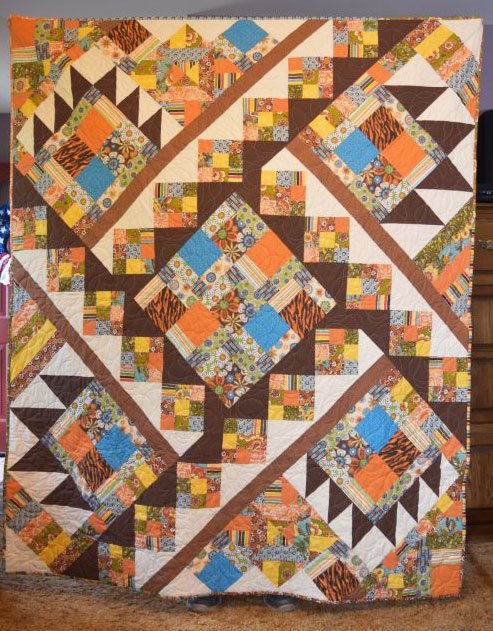
Sue’s Simple Seminole border, done in short segments on all four sides.

And Laurie has used the technique on 2 bed sized quilts.

Simple Seminole using 5 strips
Simple Seminole using 3 strips (laid out, but not yet trimmed and sewn on)

I recently put together a 3 hour workshop on Seminole piecing and taught it at the Wisconsin Museum of Quilts and Fiber Art earlier this Summer. It was a hit! I’ll share pictures from the class and some background information on Seminole piecing in next week’s post.
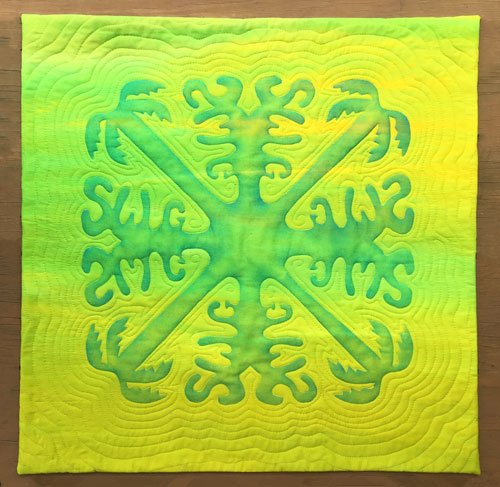
Strip Pieced Topper

July 30, 2017 2 Comments

My friend Barb sent me a picture she found on Facebook of a lovely table topper. It was a pattern by Ruthann Eckersley called Sew Easy Strata Star (all of her patterns are available at: https://ruthsquilting.com/patterns/).

I decided to play with this design, but in my own way (of course). I pulled out a 1 yard batik from my stash that was dyed in gradation,

and cut it into 1 ½” strips.

I sewed these strips back into strata and cut the triangles to make the topper. I didn’t have enough fabric for the small triangles that complete the 3D effect in Ruth’s pattern, but was happy with the spinning star. Here are the 3 possible layouts I came up with:

I pressed the strata using my strip stick. It’s a wonderful tool, and I posted about it a few years ago https://chrisquilts.net/?p=3497. It was so helpful in this project, because I wanted the seams to press crisply. The Strip Stick is a padded piece of half round moulding covered in muslin. By laying a seam at the top of the curve, and pulling the adjacent strips down with my thumb and forefinger,

I’m able to press the seams to the side without any pleats or puckers on the right side. It also allows me to only press one seam at a time. I love it!

To purchase your own, go to: http://www.thestripstick.com/.

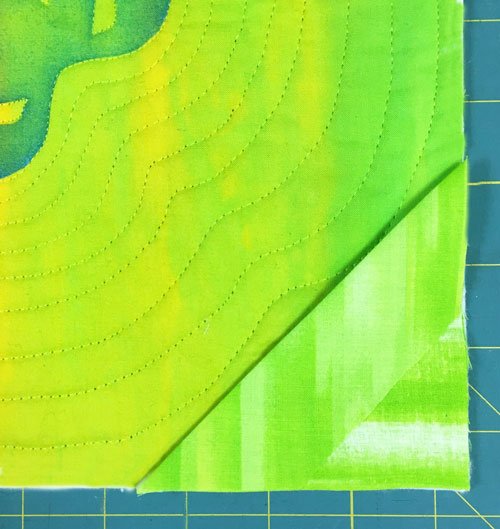
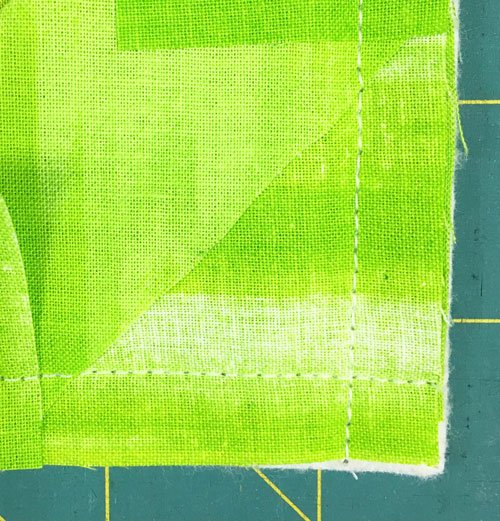
Since I didn’t have enough fabric for the pieced corner turn triangles, and I didn’t want to figure out how to finish those 45 degree points, I added corners and made a square.

It’s ready for quilting, but I really wanted to try the original pattern, so I pulled a gradation of blues and greens out of my stash and here’s the results:

I like them both.

**************************

And I’d like to leave you with this parting picture my friend Eileen’s husband took of her while she was quilting.

She had quite a special helper :-)! Thanks for sharing the picture Eileen!

Ice Dyeing

July 23, 2017 3 Comments

I’ve had so many fun posts to share recently that one from my trip to Paducah got pushed to the bottom of the pile. When I discovered this I just knew it had to be this week’s topic!

I’ve tried dyeing fabric and would usually rather buy from those who are good at it. Never-the-less, Laura and I both decided to sign up for Cindy Lohbeck’s class on Ice Dyeing during Quilt Week in April – and it was a BLAST! Here’s one of my favorites from the 14 fat quarters I went home with:

Cindy is a great teacher and has developed her own techniques that are virtually no fail. She was featured in the most recent issue of American Quilter Magazine and I would recommend her classes to everyone.

We purchased a kit for the class which included her specially prepared for dyeing fabric, the dyes and almost everything else we needed: We did a bit of pre-treating of the fabric, twisted and turned it in a number of different ways, and then placed it in Cindy’s very clever “sling” type holder.

She showed us how to mix the dyes –

how to layer the ice and then how to apply the dye to get the best effects:

We had the choice of a number of different color palettes. Laura chose the dark one above and I chose the lighter.

Once the ice melted, the fabric looked really yummy!

We took our bins home to do the rinsing, It was a bit tedious,

but the unveiling of each piece made it so worthwhile. Here are two more of my favorites:

Once they were rinsed and dried we laid them all out on the deck and took turns picking so we each got a good mix of lights and darks.

I highly recommend Cindy. To learn more about her classes, fabrics, and “Dye It Yourself” kits go to: http://www.handsonhanddyes.com/about-us.htm

Patriotic Pinwheels From Scraps

July 16, 2017 3 Comments

It seems I can’t get away from playing with my scraps lately. You may remember a few weeks ago –  I ended up with a 1/2 yard of patriotic fabric made from the leftovers of two “Quilts of Honor” tops I’d made. This is what that “chunk” looked like (click here to read that post):

The week after I made it Patched Lives Quilt Guild had Jan Bretzel give a lecture titled “Making Quilts that Look Complicate but are Not”. One of the quilts she showed was made with a simple piecing technique she shared – and I had to try it!

So I cut my patriotic “schnibblework” into 10″ squares, along with 10″ squares of a solid red fabric. I layered 1 square of each, right sides together,

Patriotic pinwheels

sewed all the way around this square with a 1/4″ seam allowance,

cut on both diagonals,

pressed the resulting new squares open,

and voila – a lovely pinwheel block!

So far I have 3 blocks made and I can’t wait to make the rest. Each one is so interesting because of the unexpected nature of the scrappy squares. I’ll post a picture of the pinwheel quilt top – when I get it put together.

Thanks Jan, for a great lecture – and for teaching me a fun new technique!

Appliqué Animals

July 2, 2017 74 Comments

Back in June I took a “raw-edge” appliqué workshop with Barbara Beasley. It was organized by my dear friend, Laura, and we had a great time (thanks Laura!)

Barbara is an amazing talent!

And if you’re not familiar with her name, you will probably recognize her by her work. Here are just two of the many pieces she has posted on her website:  http://www.barbarayatesbeasley.com/. Many of them are for sale!

Each student was to bring a picture of either flora or fauna, a photo enlargement, fusible web and a lot of fabric. Her technique was very interesting and the results in just our 6 hour workshop were wonderful!

My friend Evelyn (of Quilt Sissies fame 🙂 ), chose to do a special cat. She was amazed at the amount of blue in the picture – for a cat that wasn’t blue.

Laura decided to portray her cat in unexpected fabrics.

I can’t wait to see some of these finished!

I chose to do our grand-dog, Moseley. He’s a very pretty Australian Shepherd (photo courtesy of my daughter-in-law Betsy).

Here’s my “Moseley in progress”

and here’s Moseley!

Next I need to find the right background. I cut him out and placed him on a number of different fabrics and I’d like your opinion on which to use, or suggestions for other options.

background 1
background 2
background 3
background 4

Please comment in the box at the bottom of this post to vote for your favorite, or offer other suggestions. If you don’t see a comment box, click on “Appliqué Animals” at the top of this post and scroll back down to the bottom.

I love taking classes and learning new techniques. This was a fun class and a great technique. Here’s a challenge to anyone in that class. If you finish your piece and send me a picture, I’ll be thrilled to post it on my blog!

Schnibblework 3 – Diamond Cutting

June 18, 2017 1 Comment

To make the bright schnibblework star in my previous posts, I used a technique I developed a few years ago for cutting accurate diamonds. I’m quite sure I didn’t post about it then – so I think it’s about time to do so.

Whenever you’re making diamonds that will be sewn together, it’s important the angles and sides are all consistent. While teaching a lone star class I found the “squaring up” of the diamond step to be the most confusing part for students. My answer to this problem? Freezer paper!

To begin, cut a strip of freezer paper the finished width you’d like your diamond to be (mine was 6 1/2″)

Next, cut one end of the strip off at the angle you need by lining the bottom edge of the strip on the correct degree line on the ruler (diamonds can be 45° or 60° – mine is 45°). Please ignore the lines on the cutting mat and look only at the ruler and the freezer paper. I apologize for the optical illusion created by the paper not laying square on the mat.

Then cut the diamond from the strip at your finished measurement once again.

Viola!

Now it’s time to go to the fabric. Piece your schnibblework chunks until they are at least 1/4″ bigger than the freezer paper diamond all the way around.

Iron the freezer paper diamond to the right side of the schnibblework, making sure there is at least 1/4″ of fabric beyond the paper all the way around. Trim 1/4″ from the edge of the freezer paper with a rotary cutter and ruler.

Then peel the paper away.

This sample was cut at 7″ and will finish at 6 1/2″. The reason I cut the paper the finished size and add the seam allowance when cutting the fabric is accuracy. It is difficult to cut along the edge of freezer paper without shaving some of the paper away, and each little shave changes the diamond for the next cut.

Once I had eight of my schnibblework diamonds cut, it was time to pick a background fabric and sew them all together. None of my “safe” fabrics looked good with all those scraps, so I pulled out my wild fabrics and found the perfect option 😀 .

Remember this requires “Y” seams to set in the background squares and triangles.

I’m not sure what should happen next to this star, but I’m looking forward to some scrappy bordering fun! Stay tuned!

Schnibblework 2 – Scrap Piecing

June 11, 2017 2 Comments

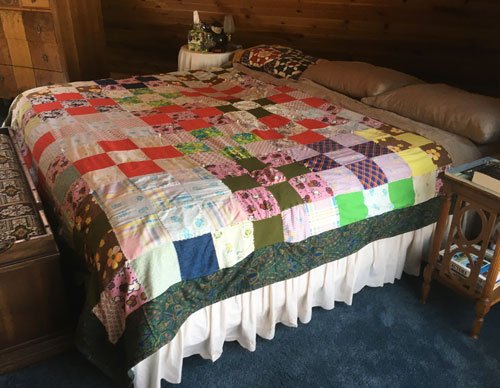
As I was taking the winter quilt off the bed this week (and just in time – the 90° days have arrived), I realized it also contained an early piece of Schnibblework. This quilt was made in a “round robin” at a guild I belonged to back in the 90’s – and it ended up King size!

As you probably know, each participant in a round robin puts a block in a bag and then exchanges it within a group, each participant adding a border. This one had 5 exchanges before I got my center block back (and then I turned the large square I received “on-point” to make it fit my King bed). That center block was made from small white, cream and green schnibbles I gleaned from the fish bowl.

This was truly a successful “round robin” quilt and it has been slept under for decades! All the quilts I’ve shared so far show that scraps can be sorted by value or color – or not sorted at all.

So how did I make the Schnibblework for the star in last week’s post?

By sewing together loads of odd shaped leftover scraps without sorting!

It got me to thinking about a book I purchased a few years ago by Victoria Findlay Wolfe called “15 Minutes of Play”. In it she sews her scraps together to make what she calls “made fabric”, and then uses it in her quilts. Great minds think alike. The twist was – I decided to create what I call schnibblework because I can’t stand to waste fabric or leave it lying around in piles. Victoria considers doing this quilting play. What a great attitude!

I adjusted my attitude to match hers and really did have fun making this very bright and colorful star


Last week I alluded to how I did this. This week I’ll explain a bit more. First I grab 2 pieces from my fishbowl,

and sew them together.

chaining more and more until I get bored. Then I go to the ironing surface and press.

After pressing I cut the pieces apart (the pile on the left is pre-pressing and the one on the right is post-pressing).

Next I go to the cutting mat and straighten off all uneven edges (note the pile at center top – these are the shavings I allow myself to throw away!)

I then pick up 2 of these new pieces and repeat the process.

Continuing until the pieces are “big enough” for the shape I want to cut them into (note that some of the chunks below are not quite big enough to be cut into diamonds with the freezer paper template on the left).

Here’s my method “If it’s too small, sew something on. If it’s too big, cut something off”. It’s pretty basic, but it works!

In next week’s post I’ll share my unique technique for cutting diamonds! I think you’ll find it a great one to have in your “quilting toolbox”!

Schnibblework Scrap Quilts

June 4, 2017 12 Comments

This past weekend I taught for a lovely group of quilters in Morris, IL. During our lunch break in the Saturday workshop we got into an interesting discussion about scrap quilts. My definition of a scrap quilt is a quilt made from leftover scraps. Some may argue this point, but buying a lot of different fabrics to make a scrap quilt, when I have so many leftover pieces from previous projects, just seems silly for me.

A few years after I began quilting (we’re talking early 90’s), the frugal part of me was really struggling with all of the leftover strip pieces, chunks and partial blocks that had begun to take over my sewing room. What do you do with them when a project is completed? The pieces aren’t big enough to put back into the stash, but they’re too large to just throw away. I chose to put the small schnibbles into a fish bowl, and I threw the larger ones into a covered bin, but these containers were filling up – and driving me crazy! Something had to be done!

I decided to sort the small schnibbles into lights and darks, and simply piece them together rather willy-nilly. When the chunks were large enough I cut them into 4″ squares and ended up making a small quilt I called Confetti (26″ x 30″).

As you can see, I had a great time embellishing it with machine stitching, buttons, beads and ribbon.  I decided it was fun, but it didn’t make much of a dent in my schnibble pile. So I pulled out the bigger pieces, sorted by value once again, and sewed them into larger squares in my scrappy fashion.

This time I sorted the schnibbles into lights, darks and mediums – sewing them into 6″ squares. Four light squares were then sewn together to make a 12″ light block and the same was done with the darks. I had enough red strips in my scraps to border a checkerboard set of the light and dark blocks, and the outer border was made up of all the 6″ medium squares. This did make a dent in my schnibble pile – as well as a lovely lap quilt 🙂 .

I did more of this type of piecing here and there over the years, but never seemed to be able to keep up with my leftovers. A few years ago my friend Lori, who makes amazing scrap quilts, accepted a large plastic bag full of my scraps. Whew! But since then I’ve filled up my fishbowl once again – and it’s flowed into another glass jar – YIKES!

It was time to do something again. Three weeks ago I started sewing anything to everything (no value sorting this time) and, after about an hour of “chunk making”, I laid the chunks on the floor and attempted to take a picture. Trey plays nicely with toys in the sewing room while I’m quilting, just like Sommer did before she headed off to kindergarten. But when I laid them out he couldn’t resist the temptation to jump into the picture.

and then he gave them the snuggle test. I think he approves.

When the chunks got big enough I cut them into large diamonds. I then sewed the diamonds into a large star and found a fun fabric to use for the background:


Can you say bright? It really makes me smile and I’m thinking it needs to grow into something bigger and even more fun. Stay tuned.

For step-by-steps on how I piece the schnibbles, please join me for next week’s post. The following week I’ll cover “diamond cutting”. There’s a good possibility this could grow into a multi, multi-week series of posts – I have a lot of scraps!

  • « Go to Previous Page
  • Page 1
  • Interim pages omitted …
  • Page 47
  • Page 48
  • Page 49
  • Page 50
  • Page 51
  • Interim pages omitted …
  • Page 78
  • Go to Next Page »

Primary Sidebar

Archives

Recent Posts

  • Squirrel!
  • Bird Quilts
  • Crazy Quilters 2026
  • Spring Thaw
  • Quilting in Bloomington ~ Part 2

Recent Comments

  • Laurie Neubauer on Squirrel!
  • Mary Wedor on Squirrel!
  • judy raddatz on Squirrel!
  • Gail on Enlarging a Finished Quilt
  • Doris Rindfleisch on Bird Quilts

Categories

Footer

My Guide

Whatever you do, do your work heartily, as for the Lord rather than for men.

—  Colossians 3:23

Contact Chris!

  • Home
  • About
  • Gallery
  • Classes
  • Trips
  • Books
  • Blog
  • Contact
  • Sign Up For My Blog

Copyright © 2026 · Chris Quilts · Website by Adunate · Privacy Policy