Last week I shared some of the contemporary and art quilts from the show. This week’s quilt photos include quite a variety. I’ll begin with a few from the “Traditional” category.
If you like scrappy triangles, you’ll love “Cut Glass Rose Bowl” by Judith Caroline Lynch of the UK. The roses are in the quilting.

“365 Quilt Challenge” by Teresa Kelly Cuthbert of the UK is a delightful sampler quilt.

“Star of Wonder” is another spectacular sampler quilt. It was made by Brenda Clough of the UK. Just look at the variety of blocks ~ and half blocks ~ she’s used to make all the wonderful stars:

“Oh My Gosh” by Liz Merckel of the UK contains 14,531 pieces, some of them just 1/2″ finished!

And if you like traditional appliqué, these two quilts were stunning! “Spring Thing” by Claudia Scheja of Germany was a variation of a traditional pattern and the quilting design fit perfectly.

“Kentucky Rose” by Sandie Lush of the UK also has wonderful quilting, with a much more subdued color palette, and it’s oh so lovely.

As I was sorting my photos I found two monochromatic blue quilts that really intrigued me. “Every Quilt has a Voice” by Glenys Davies of the UK includes zippers and other bits from old jeans, along with lots of denim ~ in a landscape!

“Monochrome Sketch no. 1” by Grazyna Ryszawa of Poland was not made from jeans. She used what she called a “confetti” technique.

Here’s a close up:

There were also quite a few portrait style quilts, and the variety of styles was fascinating. The figure in “Peaky Blinders” by Amelia Hanratty of the UK was done raw edged.

Whereas the image in “Shadow” by Scott Culley of Germany was made with a pieced Greek key type of block.

“Forgotten Stories – Woman from Urzecze” by Magdalena Gasowska of Poland was made to preserve the heritage of her ancestors.

Dee Bushrod, a British quilter who made this quilt in Oklahoma, used a pixelated mosaic technique to make a lovely tribute quilt of Queen Elizabeth entitled “Thank you Ma’am For Everything”.

And then there were the hexagon quilts. I’m not sure if they all were made using English Paper Piecing, but this style is certainly popular there. Marion Goodrich of the UK used hexagons to make diamond tumbling blocks in “Baudelaire Blue”.

While Grit Kovaks of the UK used many colors to make “Grit’s Serendipity” with over 12,000 pieces.

Lesley Arber of the UK stitched over 17,200 pieces together to make “Perseverance”, and she also counted the hours it took ~ over 2000!

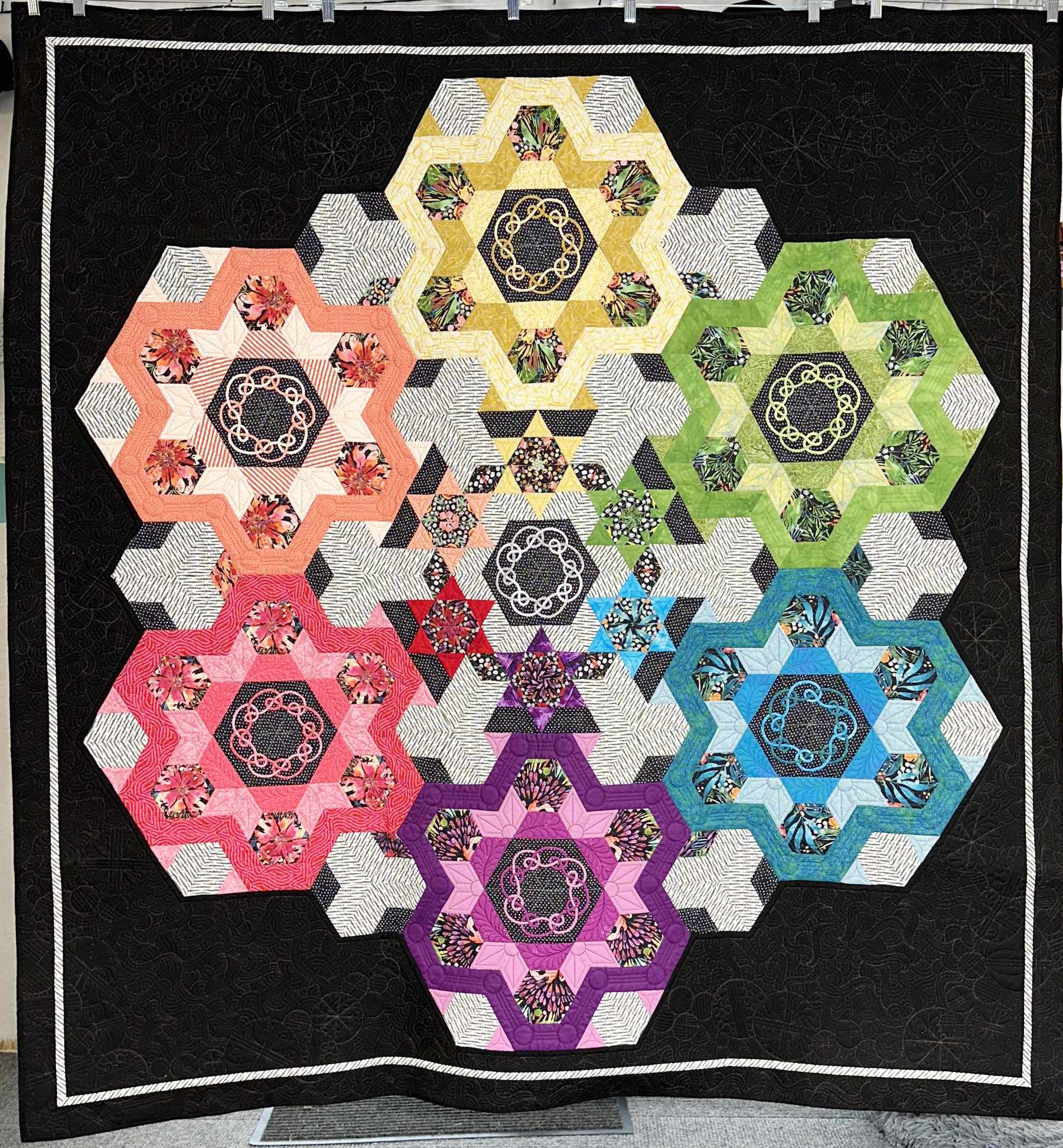
“Hope Flows” by Angela Southey of the UK used an intense color scheme and a very unique pattern for her hexagons. What a great effect!

This 2 person quilt made by Aitchbee and Helen Howes of the UK is named “Blue Moon” and uses hexagons in a very artistic way.

If you’ve been reading my blog for a while you may remember how intrigued I am by the One Block Wonder quilts made from printed panels. “In the Amazon” by Victoria Miller of the UK is another lovely example.

It was so interesting to discover that the “panel” used in “Jeju” was actually a photograph taken by Korean quilter Kyungjoo Kim, which was digitally printed onto fabric multiple times. Wow ~ what amazing creativity!

At this point I need to include a photo of a quilt that was not in the competition. There was a wonderful exhibit of antique British quilts at the show and this top, circa 1820, just had to be included here (did I mention the show had something for everyone?)

Oh my! So many different ways to use hexagons!
Well, it looks like I’ve gotten a bit long-winded again, and I haven’t even gotten to the “Quilt Creations” category or the classes I took. So I guess I need to do at least one more post about the Birmingham show. Please stay tuned ~ again 😁.
*****************
And one more thing:

I’d love to have you sign up for my lecture and/or workshop. Click here for all the information. Hope to see you there!