• Skip to main content
  • Skip to primary sidebar
  • Skip to footer

  • Home
  • About
  • Gallery
  • Classes
  • Trips
  • Books
  • Blog
  • Contact
  • Sign Up For My Blog

Blog

My New Arrival

February 21, 2021 14 Comments

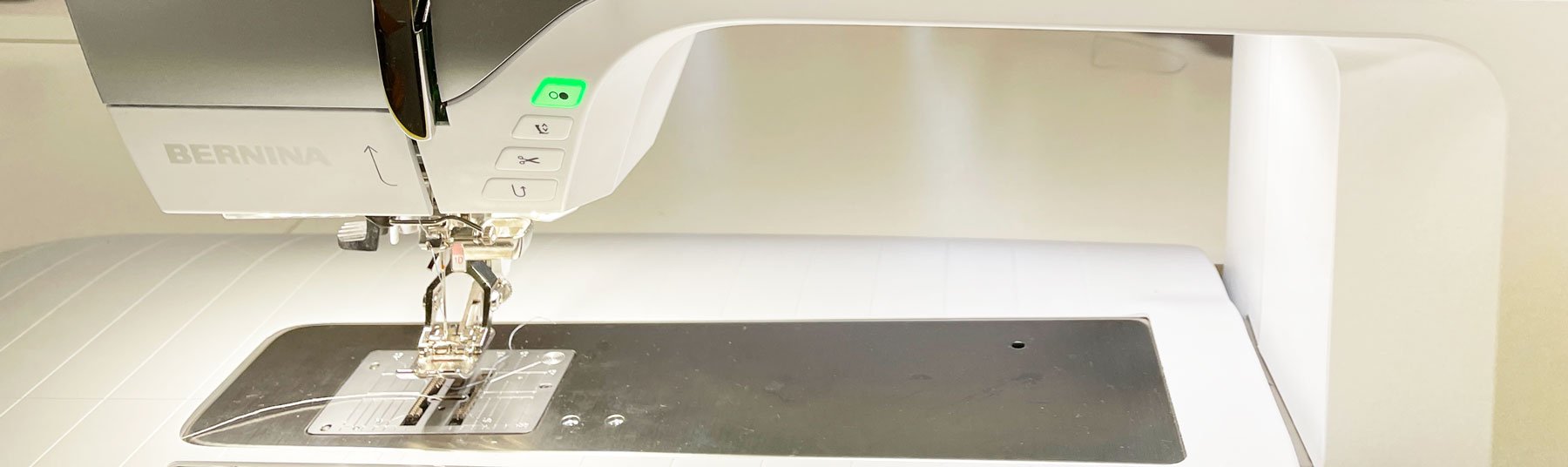
At the last quilt retreat my older sewing machine was giving me some trouble. It’s been having issues for a while and I keep struggling along. My friend Cathy told me I really needed a new machine and that thought started to percolate. A while later I told Mike about my machine issues and he responded “get a new one”. Now what quilter would let that suggestion go unfulfilled??? So I called Wendy at Sew Much More in Waukesha and that afternoon we had a new member of the family! Wendy recommended the Bernina 770 Quilters Edition, and that’s what Cathy had recommended also. My friends know me well 😊.

I’d like to say it dropped into my Tracey’s Table and I was ready to sew, but that wasn’t what happened. The machine was less than 1/4″ too wide to fit into the well on my table. My dear husband was able to enlarge the opening to fit and I was so grateful (even though it delayed my using the machine for 2 days). It was worth the wait.

Since I’d finished my most recent challenge quilt, I was between projects. But I really wanted to sew! So I pulled a stack of scrappy blocks out of my UFO bin (click here for the post about these blocks) and laid them out on the floor. Last week we had Barb Eckmeier do a Zoom lecture on Sashings and Cornerstones at Patched Lives quilt guild, which inspired me to do more than just sew the blocks to one another. I chose my sashing fabrics, cut some strips and squares,

and I was finally sewing.

I’m loving this new machine. It hums along quietly and the lighting is excellent. It has an 11″ opening, a built in “walking foot” (even feed), and the extra large bobbins are icing on the cake.

All this and my specialty feet from my old Bernina actually fit this new one. Hooray! I especially love the simplicity of the face panel.

The basics are all there without having to go into the computer screen: stitch width and length knobs, needle position, needle up/needle down, etc., all there and easy to find. I am getting used to the computer options – and I’m looking forward to my first class!

And did I mention it has a stitch regulator? I didn’t think I wanted it, and I’m not very good at it, but I’m keeping an open mind. I’ll let you know how that goes 😄.

My machine is calling, so it’s time to go and sew. See you next week!
Binding Odd Angles

February 14, 2021 7 Comments

I few weeks ago Lynn emailed me and asked:

“Do you have a favorite way of binding an hexie quilt?”

As usual – I do 🤣. In reading over her question I realized there are at least two things that come to mind when I think of a hexie quilt. One would be a quilt made up of many hexagons, like this antique Grandmother’s Flower Garden quilt from my husband’s side of the family:

Since these hexagons are only 1 1/2″ in size, binding this quilt would be a real pain. Whoever made it must have agreed and instead she stitched it to the backing all the way around and turned it right-side-out, envelope style. It was quilted after the layers were put together. This is how I finished my Christmas table toppers this year too:

The other possibility is to bind around the edges as I did on my Octabulous Star quilt:

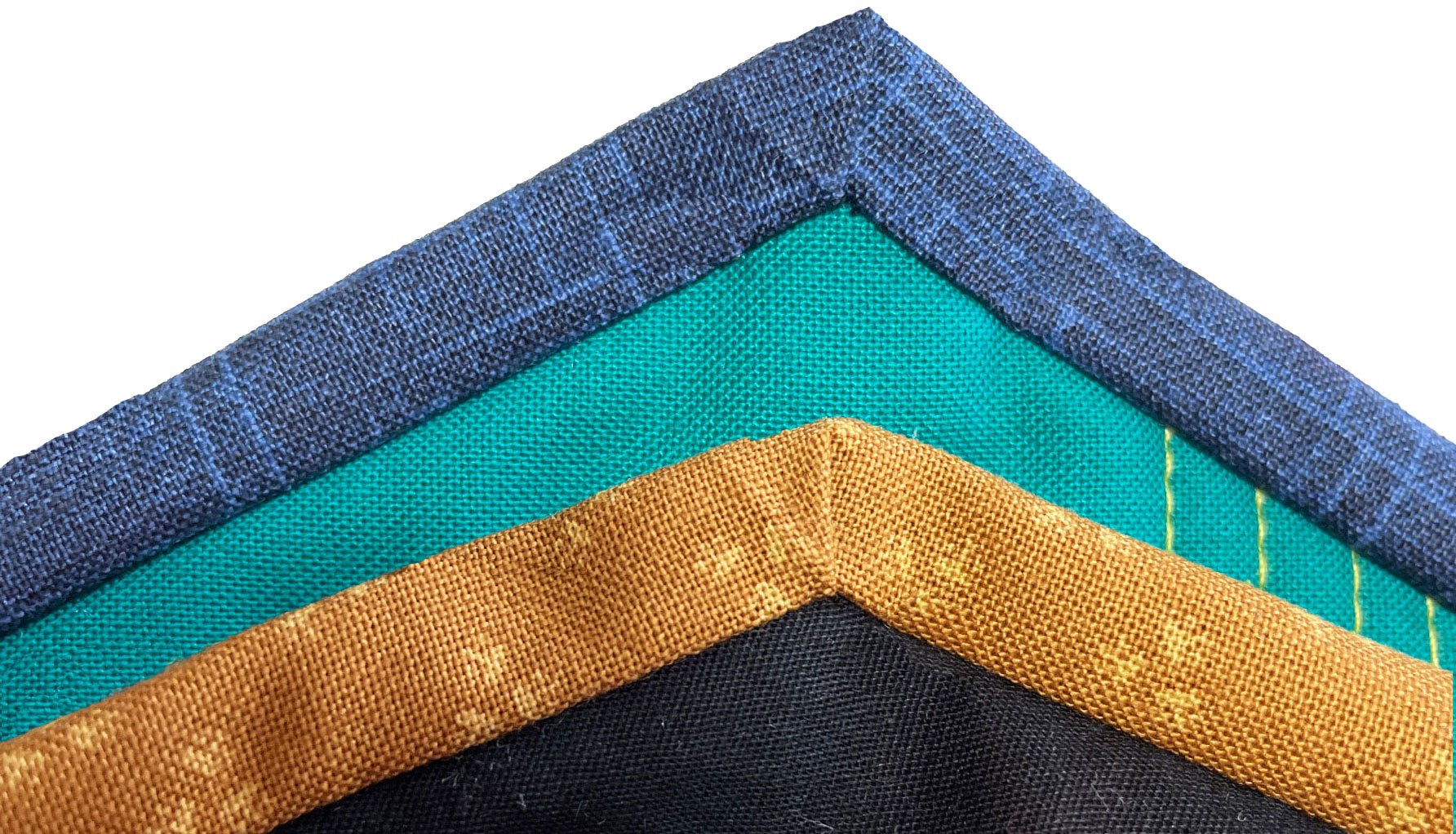
Now I know that an octagon is different from a hexagon, but my binding technique works equally well for both. This quilt is 40″ wide and I bound it with the orange floral fabric. The corners on either shape are greater than 90 degrees (obtuse) and I bind the corners in the same way I do a square or rectangular quilt. Here are the diagrams from my binding handout for a 90 degree corner:

Use your desired binding width as your seam allowance (ie. 1/2″). Stop and backstitch this distance from the next corner.
Fold the binding strip up at a 45 degree angle. The raw edge of the binding will create a straight line with the next edge to be bound.
Fold binding strip down over quilt, and continue stitching.

And that’s it. So how do we adjust for odd obtuse angles? Let’s do the octagon first. I use a single binding, but this technique works just as well for a double (French) binding.

Stitch the binding to the squared up quilt. Be sure your seam allowance is the same as the width you’d like your finished binding to be (mine is 3/8″). I’ll be ending the stitching line 3/8″ from both edges at the corner, and I have an easy way to determine where that spot is!

Stop stitching about 3″ from the corner, fold back the binding strip exactly at the corner of your quilt, with the strip completing a straight line with the next edge of the quilt to be bound (the ruler is there to show the continuation of the edge). Crease this fold with your fingernail.

This crease will be exactly on top of the corner of the quilt:

Lay the binding strip back in place and sew to the crease, ending with a backstitch. Remove from machine.

Fold the binding back over the crease,

then fold it down through the corner,

laying the edge of the binding along the new edge to be bound. This creates the perfect angle without any measuring.

Begin sewing near the crease, and continue down this new edge. Repeat around entire quilt.

To turn the binding to the back, bring the entire binding around to the back of the quilt. It will want to “cup” at the corners. Choose a corner and fold the raw edge of the binding strip even with the raw edge of the quilt.

Next fold the portion on the left down tight around the quilt edge and flat against the back (a double binding strip will already have the fold and needs only to be folded down over the previous stitching).

Fold the next side over the edge of the quilt, gift wrap style, adjusting the crease to fit from point to inside corner. You may have to fiddle a bit to get it to lay correctly. It’s worth trying a few times to get it right.

Pin.

And this is how it looks on the front:

Hand-stitch binding in place around entire quilt.

Binding a hexagon is the same technique and, because we didn’t have to do any measuring, the angle may be different but it doesn’t matter.

Stitch the binding strip to the quilt, fold the angle, and crease as before:

Backstitch and remove from machine:

Fold binding strip back along previous crease, and then in place along the next edge as with the octagon binding, and continue:

The turning to the back is done as with the octagon also. And here are the pinned corners of both angles:

There is a search box on my site to locate these tutorials whenever you actually need them, or they can be printed from a computer by simply clicking on “File” at the top of the screen, then “Print”, and follow the prompts.

Quilt Float Revisited

February 7, 2021 4 Comments

Before I jump into this week’s “topic”, I just have to share an email I received from Peg:
“This is a great post. I do have a question. Can’t you simply measure the diagonal of the raw edge blocks, average them, and cut your squares that size plus 1 1/2?”

My response? – I wish I’d thought of that!!! So, instead of laying out 2 blocks and measuring the space between their points (as in last week’s post):

you’ll get the same results by simply measuring the diagonal of an unfinished block:

Either way the result is 8 1/2″ for these 9 patch blocks and 1 1/2″ can be added to that, resulting in 10″ squares that will be cut on both diagonals! Thanks Peg!

*******************

And now for this week’s topic!

A number of quilters have recently asked about my Quilt Float system. It’s not a medieval torture device, but rather a great way to make quilting a large quilt less stressful.

The time to revisit this topic has arrived! I wrote my original post back in 2012. Many of you weren’t reading my blog back then, so this is for you 😊 – or for anyone who’d like a refresher.

The idea behind this contraption is to “lift” the weight of the quilt so that it doesn’t pull and drag as we quilt large projects. It works with any sit down machine. My studio is finished so I can’t hang things from the ceiling, but if you sew in an unfinished basement, you could easily hang the chains from nails in the rafters and avoid the support structure altogether.

To “build” your Quilt Float I’m reposting portions from that first post in 2012 here, along with some updated photos. It begins with helpful set up hints for quilting large projects:

“Before we get to the actual frame, there’s a few tips I’d like to share. If your sewing machine is in a cabinet – great. It is also helpful to have some support to the left of the machine. If you don’t have any, placing an adjustable ironing board there is a good solution.

If you don’t have a cabinet you will want to find a way to avoid “sewing on a mountain”, ie: with the machine perched on top of a table or desk. Even table extenders don’t solve this problem with a large quilt because pins and folds of quilt get caught on the edges. My best suggestion is to place a card table in an “L” against your kitchen table or a banquet table. Then set the machine on a tv tray in the inside corner with enough magazines to make the bed of the machine flush with the tables.

Now you’re ready to float the quilt. All of these supplies can be purchased at your local hardware store.”

2 Lengths of Chain (approximately 18” long – links should be 1 ½” long)

2 Bull Nose Clips (1”)  These can be found with office supplies. They are inexpensive and will clip and unclip the chain together very easily to adjust the height of the floating quilt.

2 Spring Clamps (6” long) These are plastic, fairly inexpensive and have holes in the handle ends for attaching the chains. They squeeze to open.

2 Slide Clamps (36” long)  Both the old fashioned “C” clamps that screw to tighten or the deluxe new ones that pump tight will work.

Choose the best quality clamps you can afford. I took my husband shopping and thus I own the Cadillac of clamps, but I did wait until they were on sale. They are very easy to use! It’s important to have a hole in the bar at the non-clamp end for a rod or bolt to go through.

1 Top bar – you’ll want the “Quilt Float” positioned about 1 ½ feet behind the sewing machine. Depending upon your space, you’ll need to choose a “top bar” option:

1. If your table/cabinet is less than 6’ wide and more than 1½’ deep you’ll want to place the clamps on the sides (as in the clamp photo above). For this arrangement you’ll need: 2 bolts and 2 wing nuts that will fit through the holes at the ends of the Slide Clamps, and a length of aluminum slat that measures at least a foot longer than the width of your table/cabinet, with holes at even intervals along the length (mine had no holes so my husband drilled them to fit my table – he also painted it black 😊).

2. If your table/cabinet is more than 60” wide and less than 2 feet deep, you’ll want to place the clamps along the back of the table. For this arrangement you’ll need to buy a ¼” diameter Steel Rod (4’ long). This is the arrangement I used at retreat:

The rod will slide through the hole in the end of the long clamps.

And that’s it! Attach your support frame to the table, place your quilt under the machine, reach back and grab a handful of quilt with the spring clamp (as in the photo at the top of this post. Voila – your quilt is floating and the process of quilting will be much more enjoyable. I guarantee it!

And just out of curiosity – are any of you using a Quilt Float of this design? Please comment or email me at .

Setting Triangles

January 31, 2021 9 Comments

If you’ve been reading my blog for any length of time, you probably are aware of my “seat of the pants” style of measuring. When other teachers are coming up with the perfect mathematical formulas for getting things to fit – I’m trying to come up with an easier way. Most times accurately cutting and measuring are the way to go, but occasionally quicky techniques work just as well… or better.

A few examples would be a post I did for “Turning a Block On-point” or another I entitled “Fitting Borders – Mathlessly” (simply click on each title to visit those posts).

This time I was inspired when my friend Mary emailed me asking:

“When you put a block on end,  can you tell me if there is a formula to know how big to cut the set in triangles? 

To add triangles in a row as in the image above, you simply need to cut squares the proper size and then cut these squares along one diagonal. Calculating the actual measurement for this is quite easy to do. When adding seam allowance to a square or rectangle quilters add 1/2″ (1/4″ seam allowance for each side). When cutting triangles there is an additional seam and, since it’s a diagonal one, 3/8″ needs to be added to the original 1/2″ (you don’t need to know the math – just trust me 😊).

So let’s assume the the blocks above were going to finish 6″. To cut a square that would yield two setting triangles, 7/8″ should be added to the finished size (1/2″ + 3/8″). Thus the square should be cut 6 7/8″. BUT WHO WANTS TO CUT 7/8″ INCREMENTS??? Instead we’ll add 1″, making it a 7″ square. This little bit of extra gives us some wiggle room and can easily be trimmed off when squaring up the row.

To make the “D” triangles above, you can cut 4 by adding 1 1/4″ to the finished size of your block and cutting this square on both diagonals.

Now… what if you want to cut setting triangles for a diagonal set quilt?

These triangles may be cut using the technique above so that they will fit precisely, but that leaves a bias edge around the entire quilt and I dislike the potential for stretching this creates. Also, I usually want the setting triangles around the outer edge of a quilt to be a little over-sized so the quilt blocks will “float”. This prevents the corners of the blocks from being cut off. Here are my “seat of the pants” measurements for quickly determining how to cut these triangles:

  1. Lay the cut quilt blocks point-to-point, using a ruler to align them properly. As you can see, these blocks are finishing 5 1/2″ (6″ unfinished):

In order to have a straight of grain edge around the quilt we will cut an oversized square of fabric and then cut it on both diagonals, yielding 4 triangles. To do this lay the ruler from point to point:

My measurement for the 5 1/2″ finished blocks is 8 1/2″. I added 1 1/2″ to this measurement and cut a 10″ square (yes – 1 1/2″ no matter the size of the blocks – again, just trust me). This will yield a good sized float which allows plenty of excess to square up the quilt top without cutting off block corners:

Each triangle can be placed between a pair of blocks when laying out the quilt:

Once all the triangles are cut the quilt may be laid out (I’m showing only a portion of my quilt for demonstration purposes):

The triangles are placed at the ends of the diagonal “rows” and sewn on with the right angle corner of the triangle even with the block. Once all the “rows” are stitched they may be sewn to each other:

Even thought this is only a portion of the finished quilt, you can see that there is more than 1/4″ of black around each red corner.

Once the quilt top is all together the corner triangles can be made by adding 1 1/2″ to the finished size of your blocks and cutting two squares at this measurement. They may each be cut on one diagonal, yielding all four corners.

For those of you who are perfectly accurate when stitching – please use the precise measurements. For those of you who are off a little here and there, welcome to the club, and enjoy my hopefully helpful “seat of the pants” techniques.

*******************

And just a short note about another Wonderful Retreat!

I just returned from yet another weekend away with some dear quilting friends. Laura is such a blessing to me in so many ways, and her organizing of quilt retreats is just one of them. This time 7 of us gathered at the Tall Pines Quilt Retreat in Mukwonago, WI (click here for more information). Our visit was definitely snowier than this photo!

Laure and Hans have done a wonderful job of making this sprawling home the perfect spot for quilters – five bedrooms, four bathrooms, and a very large sewing studio, made it a delightful place to stitch,

with wonderful friends,

good food,

and quite a bit of crazy fun!

Thank you ladies for a fantastic getaway!

W.O.W. – A Live Quilt Show!

January 24, 2021 14 Comments

I have been missing real live quilt shows terribly. Virtual shows are ok, but I think a great majority of the fun of a show is sharing it with others. That’s why I was so excited when I received a “call for entries” from Mary Beth at the Walls of Wittenberg in central Wisconsin. The email stated that they felt they could follow all the pandemic guidelines – and still host a show. WooHoo! I shared this info with the ThreadBenders and we were able to enter our Colored by Emotions challenge quilts in Wittenberg. They were completed in early 2020 and never had the chance to be seen “in the cloth”. A few of us also entered our Octabulous quilts from last year’s challenge.

Mike and I drove up to Wittenberg this past week to drop the quilts off. I’ve had quilts in the WOW Space before and absolutely love this charming small town in central Wisconsin. In order to show off it’s beauty and bring in visitors, Wittenberg has been covered with beautiful murals. If you zoom in on the sign below you’ll get the idea 😊:

The W.O.W gallery has this mural on the back of it’s building:

I posted a few of the other murals back in 2012, but I can’t resist sharing a few more, like the veterinary clinic:

the hardware store:

the firehouse:

the post office (which I learned was painted by Mary Beth’s daughter!):

a Main Street Law Office:

and a garage on the main drag:

There were plenty more and each one was an amazing work of art. They added brightness to a very gray day… and that was all before even entering the W.O.W. Gallery!

The show will be open on Saturdays and Sundays through February 8th, from 11 – 3.

And here’s a sneak peek of some of the quilts in the show:

And they can all be seen “up close and personal”! What a wonderful destination – and a great reason to go for a ride!

Ricochet Quilting

January 17, 2021 8 Comments

In November I posted about the fun I had using rulers to quilt our new, king size bed quilt. After finishing it I wanted to machine quilt some more – can you believe it!?!

We have a friend who is going through a particularly difficult time right now. He recently showed quite a bit of interest in my quilting, so I decided to go through my pile of unfinished class projects, layer one with plush fleece, and finish it to keep him warm this winter.

This ricochet method will work well with a walking foot on a domestic machine, but I had fun using it with a ruler on my mid-arm. I know quite a few quilting friends who have purchased the ruler foot for their home sewing machines, along with the necessary quilting rulers, but they have been hesitant to try them out. I highly recommend jumping in – but do it on a lap sized or smaller quilt 😊.

The lap sized top I chose was in my favorite warm shades of orange and brown, and was made up of oodles of half square triangle blocks.

I could have gridded the entire quilt on my home sewing machine with a walking foot, but this time I decided to have some free-motion ruler fun! I quilted all the long diagonals on the quilt with my channel ruler, connecting the corners of the blocks “free-motion”.

Each time I completed stitching the diagonal of a square, I’d slide the ruler down to the next intersection and continue the quilting line.

Now here’s the fun part – when I reached the edge of the quilt I simply repositioned the ruler on the perpendicular diagonal and “bounced” up in this new direction, as if the stitching was ricocheting off the edge of the quilt. If you are using a walking foot on your home sewing machine, the quilt would simply need to be rotated in the new direction.

In this photo I was quilting down from the upper right and am now positioned to quilt up and to the left.

I continued to bounce around the quilt in this manner and only had to stop and restart 4 or 5 times to complete the quilt. In a matter of a few hours it was done! I trimmed the fleece around the quilt at 1″, and folded it up to make a nice soft self-binding.

And here’s the quilting from the back. I think the quilting looks great on the fleece.

We gave it to our friend and he seemed quite pleased! What a blessing to be able to give a gift of love and warmth. I know so many generous quilters who make quilts out of love for others and I’m sure you all understand the joy that comes from giving a gift from your heart! Praise the LORD!

Pins, Pins, Pins

January 10, 2021 11 Comments

Last week I told the story of our granddaughter’s comforter and this week you’ll get “the rest of the story” 🤣.

My husband retired six years ago. I have recently been pushed into what I hope is temporary early retirement, from teaching quilting and grandchild daycare, by the pandemic. So Mike and I are spending a lot of time together. As with many people who are at our stage of life, we are experiencing some of the less than funny symptoms of maturity. Fortunately we enjoy teasing and laughing together.

That being said, Mike wasn’t laughing when we began pinning Hanna’s poofy comforter into the frame. Three extra-loft batts make for a really thick comforter!

I usually pin with 1″ bent safety pins, and even I struggled to get them to work along the edge of the purple fabric.

Mike struggled for only a few minutes before he threw up his hands in frustration, so I gave him the handful of 1 1/2″ pins I own.

That didn’t make him any happier and, after giving it a good try, he allowed me to finish pinning things together solo. I didn’t blame him a bit. I however did persevere and all went well.

Time went by, the quilt was finished and sent off to Hanna, and I didn’t give this situation another thought… until Christmas. Mike and I don’t typically exchange gifts (we have everything we need – praise the LORD). So imagine my surprise when he walks up to me with a smirk on his face and presents me with a Christmas present. I unwrapped it to reveal… 3″ long safety pins!!!

I laughed hysterically! Those pins are honking big!

I’m pretty sure my quilts won’t survive the size of the holes they would make!

I have a challenge – who can come up with a use for 3″ pins? I’d love to let Mike know that I like my gift and find them useful (tee-hee).

And now, the rest of the rest of the story…

I wrote this post shortly after it happened, in anticipation of sharing it with you this week, and I thought it was complete. Imagine my surprise when 3 days after Christmas Mike hands me a package that had just been delivered to our mailbox. What was inside?

The colorful 4″ pins that didn’t get delivered in time for Christmas!!!

This guy really makes me laugh. As I hugged him I glanced at my shelf only to discover I am also guilty of a pin addiction. At last year’s quilt Expo in Madison I found a unique “quilt hanger” I just had to have and, you guessed it, it’s the biggest pin yet!

It’s about 16″ long and it actually opens to slip a quilt on for display on the wall.

So I guess we were meant for each other!

PS. The pin wasn’t in the original photo – isn’t Photoshop™ a hoot?!?

Wishing you a week filled with smiles!

Tying a Comforter

January 3, 2021 13 Comments

I have one more Christmas project story to share 😊. Our granddaughter Hanna will be 15 this month and she recently redecorated her bedroom. She asked me to make her a poofy comforter: solid forest green flannel on the top with a purple flannel on the back, and the back could be a plaid. She wanted the knots tied to the back. I like a girl who knows what she wants (even if a solid green top isn’t very exciting in grandma’s opinion)!

For the top I found a flannel sheet in the requested color. I absolutely wanted a plaid for the backing, but the one I liked best was near the end of the bolt, so I needed to border it with solid purple. Once the backing was pieced my dear husband offered to help and quickly cleared a space in his shed. We thumbtacked the top fabric, wrong side up, into the frame (so the knots would be on the back), then layered on three extra loft batts, and topped it off with the purple plaid backing. Pinning the top in place with all that batting was quite an ordeal, and that story will have to wait until next week’s post, but once it was pinned the tying could commence.

I don’t believe I’ve ever posted about tying a quilt, so I figured it was about time to share some of my favorite tips. I prefer to use a light weight yarn or multiple strands of embroidery floss. For Hanna’s quilt I used a 6 strand length each of purple and green floss. It can be tricky to thread the needle with thicker threads. I’ve found this type of threader to be very helpful (and I just saw something similar at JoAnn’s):

You simply push the hook through the needle, catch the threads/yarn:

and pull them through:

I cut my thread(s) as long as the side of the quilt (yes, you read that right), and I make knot stitches in a line down the entire length of the quilt. I was told years ago to make sure the stitch length of the knot is at least 1/4″ so that it won’t pull through with wear.

I like to use a ruler to keep my stitches evenly spaced and found the plaid to be a real blessing in lining up the knots! After a line is stitched I go back to the beginning and cut the first tie so there is about 1 1/2″ of thread on each side.

At this point it’s important to grab each end and slide the piece side to side to insure there are no unwanted twists of thread underneath. Once you’re sure, tie a square knot (right over left, then left over right).

To trim the knots evenly I like to hold the tails against my forefinger and cut at the first “knuckle crease”:

Continue to tie all the knots in that line and then move on to the next. The tying went well and in no time it was complete,

It even looked good on the bottom, as seen when I peeked under the frame.

Next it was time to bind it in the purple flannel. I can’t say I love binding a project that is this thick, but I love my granddaughter – and she loved her comforter – so it was worth it! The comforter (and other gifts) made it safely to Vancouver, WA and she had it on her bed on Christmas Eve!

She said it was exactly what she wanted, and it’s so much fun to make something that brings joy!

The last time I tied a comforter was in December of 2017 when I helped my cousin make a t-shirt “quilt” for a friend who’s husband had passed away suddenly. Stitching through those layers was a bit tricky, and if you’d like to read about it please click here.

Do you have any tips for tying a comforter you’d like to share?

  • « Go to Previous Page
  • Page 1
  • Interim pages omitted …
  • Page 30
  • Page 31
  • Page 32
  • Page 33
  • Page 34
  • Interim pages omitted …
  • Page 77
  • Go to Next Page »

Primary Sidebar

Archives

Recent Posts

  • The Indiana Heritage Quilt Show ~ 2026
  • Bird’s Eye View
  • The Birds
  • Sew Much Creativity
  • A Last Minute Baby Quilt

Recent Comments

  • Kathy Wuhrmann on The Indiana Heritage Quilt Show ~ 2026
  • Doris Ast on The Indiana Heritage Quilt Show ~ 2026
  • judy raddatz on The Indiana Heritage Quilt Show ~ 2026
  • Jeanette Bussard on The Indiana Heritage Quilt Show ~ 2026
  • clkquilt on The Indiana Heritage Quilt Show ~ 2026

Categories

Footer

My Guide

Whatever you do, do your work heartily, as for the Lord rather than for men.

—  Colossians 3:23

Contact Chris!

  • Home
  • About
  • Gallery
  • Classes
  • Trips
  • Books
  • Blog
  • Contact
  • Sign Up For My Blog

Copyright © 2026 · Chris Quilts · Website by Adunate · Privacy Policy