• Skip to main content
  • Skip to primary sidebar
  • Skip to footer

  • Home
  • About
  • Gallery
  • Classes
  • Trips
  • Books
  • Blog
  • Contact
  • Sign Up For My Blog

Blog

Pleasing separation

September 26, 2011 5 Comments

This past week a student inquired about adding a very narrow border to her quilt to visually separate the quilt center from a wider border. Piecing in a 1/4″ border can be tricky and so I had some alternative ideas to share:

If you’ve ever done counted cross stitch, you are no doubt aware that once the crosses are completed, most patterns have the different color areas outlined with a line of black backstitches. Even though this line is very narrow, it adds a lot of interest and definition. Sometimes this is a good option for separating borders…and even bindings.

One simple way to do this is to sandwich piping (purchased or homemade) into the seam between the quilt center and the border.

Another idea that has been very popular recently is to fold a 1″ strip of contrasting fabric in half lengthwise, wrong sides together, and slip this into the seam. I like to refer to this as a flange and it can add a lot of punch for a small amount of fabric and effort.

One additional idea is really simple and can be done after the quilt is finished and bound – couch a piece of yarn or cording on top of the seam! Couching simply means to lay the yarn/cording in the “ditch” of the seam and stitch on top of it with a zig-zag or serpentine stitch. It can be done in invisible thread or something decorative.

And now for an example to show how helpful this effect can be:

I made the following quilt for a “Tea” challenge through the Milwaukee Art Quilters. All of the fabrics were dyed in tea and I quilted the different areas as a sampler of quilting designs.

For some reason I bound the quilt in a similar color fabric to the rest of the quilt and it seemed to look like the quilt never ended when hung on a light colored wall. So I couched a brown chenille yarn along the binding and was very pleased with the results.

That simple addition made the quilt a success in my mind :-).

What a Great Show!

September 12, 2011 6 Comments

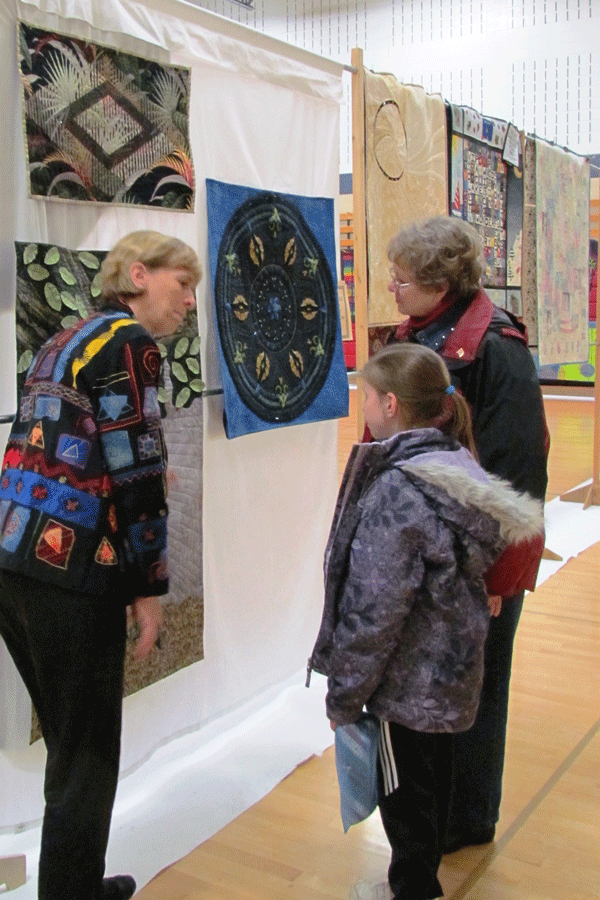
I’ve just returned from teaching at Quilt Expo in Madison, WI and it was a spectacular show. My classes were filled with enthusiastic and eager students. The aisles of the vendor mall were filled with willing shoppers and the overall atmosphere was charged with excitement.

This show has really grown from it’s beginnings and has become a national level event. They even added 30 vendors since last year!

This year I was truly blown away by the quilts in the show. Even though there were entries and prizewinners from all around the country, the number of very talented entries from Wisconsin was amazing. I spent a lot of time admiring the intricate designs and stitching in the handquilted entries and then had to come back the next day to absorb all the inspiring creativity of the fiber art.

Since my latest passion is to make the machine quilting take the quilt to higher and higher levels, I was amazed to see all the new designs and innovative placement in these fascinating quilts.

That being said, I’m sure I’ll be hearing comments from friends and students saying there were too many art quilts and not enough for the average quilter. I’d like to share my perspective on this:

Quilt Expo is a juried show and each piece was chosen from pictures sent in by the maker. Many quilts didn’t make it in and therefore the ones that were accepted had to be a step above average to be chosen. I feel the fun of a juried show such as this is to see the “what ifs” and “I could nevers” so that we may all be inspired to try something new. The quiltmakers who were represented are not your average quilter and, as a viewer, we need to keep this in mind.

This is why we need to attend the smaller, local, non-juried shows and fairs as well as the big events. Most local shows are not juried and normal quilters can go there and see things that they may actually be able to make, as well as a few “jaw-droppers”.

So don’t be too quick to criticize the big shows for the lack of simple or traditional quilts, but enjoy each show for what they are and attend as many varied shows as you are able :-).

Well, that’s my opinion, what’s yours?

Tying Up Loose Threads, Pulling Up Bobbin Threads

August 8, 2011 4 Comments

I was blown away by all the interesting comments concerning our sewing machine collections. I learned a bit of history and discovered that I don’t win the ribbon for having the most machines :-). If you haven’t been reading the comments on any of my previous posts, it’s really quite simple: go to the bottom of that post,  and click on “comments”  (the word will be in blue)!

Also, if you want to comment on my post directly to me, you can just send me an email (and I thank those of you who do). I enjoy reading these, but I often wish they had been posted as a comment to that post so others could read them too. It’s easy to make a comment to a post: once again click on the word “comment” at the bottom of that post and scroll down until you see the “comment box”, type your comment and submit.

Now for the bobbin thread tip!

When I’m quilting on a large quilt and reach the end of a stitching line, I find it awkward and difficult to reach under the quilt and cut the bobbin thread. I do have a machine with a “cut” feature, but it leaves 1″ tails. I don’t like to have them hanging around and I really don’t want to go back and trim them all off later. If you struggle with this frustration too – here’s the answer:

1. Raise the needle at the end of your stitching line.

2. Raise the presser foot.

3. Grab the thread between the needle and the quilt and pull out a loop.

4. While holding the loop of thread, reinsert the needle in the hole the thread came out of (or close to it),

and then bring the needle back out. This works great if you can just press “needle up/needle down” on your machine to make one complete stitch.

5. While still holding the original loop, raise the foot again and pull the quilt away from the needle. The bobbin thread will pop up in a small loop.

6. Cut the bobbin thread loop and the top thread close to the quilt.

Voila! It’s almost like magic 🙂.

This also works when you want to pull the threads both to the top and knot them off for burying as was discussed in my “Loose Ends” post from March 27th (click on “Loose Ends” and scroll down for that lesson).

Try it! I think you’ll like it!

Howe Many Machines Do You Own?

July 31, 2011 14 Comments

If you want to feel better about your sewing machine collection, read on. Up until recently I owned 6 (but one’s a treadle that’s being used as an end table, so I’m not sure it counts). I recently acquired #7…with my husband’s blessing, and I can’t wait to share. We were wandering through an antique store in Fort Atkinson, WI when this machine caught my eye:

For many years I’ve been presenting a quilt lecture about my collection of antique quilts entitled “But I Still Love You”. In it I share some sewing machine history, including information on Elias Howe, the “inventor of the sewing machine” (there were other machines invented in other countries, but his was the most user friendly and marketable, so he’s credited with it). There is actually a plaque on the machine with a bust of Elias Howe and the words “Elias Howe Jr; Inventor and Maker; New York, USA”.

The machine has been mounted in a case with a glass front and a light inside so that the mechanism underneath can be viewed when the crank is turned.

The case has a plaque that reads: “Inventor: Elias Howe; Patent #4750 Granted 9-10-1846; circa 1865-67; Restored by Carmon M. Howe; 1991”. I was able to contact Mr. Howe and he told me he is not related to the inventor. He found the machine on the 3rd floor of an antique store in LaCrosse, WI with about an inch of dust on it. When he saw the name – he had to have it :-). He said it won’t run because the bobbin mechanism was missing. We had a lovely conversation and he told me to enjoy the machine. I am already.

 After a bit of web surfing I found a photo of the same model machine as mine and it is indeed from 1867!  I searched for more details about the machine and found very little. I did find a wealth of information about Elias Howe and am anxious to share it in future lectures.

So, anyone own more than 7 sewing machines???

Shrek on Quilting II

July 25, 2011 Leave a Comment

I was so pleased with the positive feedback on the quilt basting frame and I have a few more frame related comments:

1. I have 2 comments that would fall under the heading “leave your pins open”. The first is good advice when you take the pins out of your quilt as you’re quilting. I always toss them in a container open and store them this way. The downside is you get poked when pulling them out for the next use, but the upside is you don’t waste energy closing and reopening. It’s much healthier for your hands -ergonomically.

2. Next, leave the pins open as you baste the quilt. I do this whenever I pin a quilt in the frame by myself. It’s easier on the back to leave the pins open, remove the quilt from the frame and then sit in a comfy chair to close them all with a Kwik Clip or grapefruit spoon.

3. Storing the boards – you’ll want to keep the boards in a dry place so they don’t get damp and warp. I’ve found that stacking them in an I-beam in the basement keeps them out of the way, yet easily accessible. Wrapping a bungie cord around the I-beam near each end keeps them from tumbling down!

4. My final recommendation is that it is definitely more fun to “frame a quilt” with friends. Last week Ida was so sweet to come over as soon as I called. What a dear friend! Many years ago I needed to baste a quilt with a deadline and had mentioned it to Sharon and Carol early in the day. Mike was out of town and the kids were in bed when I finally set the frame up in the living room. We lived out in the country at that time too, so when I saw headlights coming up the driveway at 9pm, I was a bit concerned. What a delight to see my wonderful quilting friends walk up to the door – with chocolate! The quilt was quickly basted and a good time was had by all!!

So, how do you store your pins? Do you have a “quilting friends to the rescue” story?

Shrek on quilting

July 18, 2011 7 Comments

Like ogres (and onions) quilts are made up of layers. Putting the layers together for quilting can be a daunting task…especially if it’s lap sized or bigger. I know many quilters who spread everything out on the floor but, as I age, that is harder and harder on my back and knees. My favorite way to layer a larger quilt sandwich (up to king size) is on a simple frame. I learned how to do this way back when I first learned to quilt and continue to use that original system. So, whether you’re going to baste your quilt together with safety pins or thread, or even if you want to tie it “comforter” style, this frame will work! 

The first problem we usually encounter is where to set up the frame because of the size. I find it best to set up the frame outdoors if the weather is nice or in the garage (sans cars) if it isn’t.

The supplies are quite easy:

Four 10 foot 2 x 2 boards (these tend to be straighter if you buy two 2 x 4 boards and have the lumber yard rip them lengthwise)

Four “C” clamps or bar clamps (I use to borrow my husband’s “C” clamps, but found the sliding bar clamps to work much better and I splurged on 4, which I now share with him 🙂

Four high back chairs

large head thumb tacks

Place the chairs as 4 corners on a square with the seats facing out and place 2 of the boards parallel across the chairs:

Place the remaining boards on top of the first 2 and parallel to each other:

Quilt Backing – I prefer to tear my quilt back so that the edges are straight and square. Then I mark the center of all 4 sides with safety pins. I have a pencil mark at center on each of the boards so I can line up the center pin with the center mark and thumb tack the backing – WRONG SIDE UP – to the 4 boards (notice that the edge of the backing is even with the outside edge of the board):

Next I tack the backing along each board at 8″ intervals, leaving the corners untacked:


Now comes the tricky part: beginning at any corner, pull the boards into a right angle on top of one of the chairs, keeping the edges of the fabric even with the outer edges of the boards. Clamp both boards and the corner of the backing fabric together (I like to have the long part of the clamp pointing up for easier adjusting):

Repeat for all 4 corners so that the backing is stretched square and taut:

Lay the batt on top of the back and smooth it with your hands. Then lay the quilt top evenly on the batt. For the next step it’s nice to have help, so invite a friend (thanks, Ida!). Stand, centered, at opposite sides of the quilt and “tug” the top so that there are no wrinkles between the 2 of you. Be sure the center of the quilt is lined up with the pencil marks on the frame and pin along the edge:

Work across from each other, placing pins at 8″ intervals (approx.) until those 2 sides are done and then repeat for the remaining 2 sides.

Once the quilt is completely pinned into the frame you may safety pin baste it, thread baste it or tie it! The great thing about this frame is that when you can no longer reach areas comfortably, it can be rolled. To roll the frame:

Along one of the “top” boards remove both corner clamps (while standing inside the “bottom” boards and keeping your hips against them so they don’t move in and lose the side tension). Also remove the first few thumb tacks along the side (bottom) boards only, so they don’t impede the rolling:

Now roll the “top” board so that the quilt edge rolls around the outside of the board, while pulling on the board just a bit to keep the “front to back” tension even. Continue to roll until the unpinned area reaches the board and then reclamp both corners:

Repeat for the opposite side and pin away! On larger quilts you may need to roll more than once. It’s better to roll and pin comfortably than to reach and strain, and possibly knock the whole kaboodle off the chairs!

Once the basting/tying is done: remove the clamps, unroll the quilt and take out the tacks.

It’s just that easy :-).

Next week I’ll have some tips for pinning, storing the frame and enticing others to help.

Corner Labels

July 10, 2011 7 Comments

This past week I came up with a really simple way to label a quilt and I can’t wait to share! It’s a variation of a quilt hanging technique I’ve used for years that works great on small quilts. To simply hang a small quilt: fold 2 squares of fabric in half diagonally and place them in the top corners of the quilt before binding. When the binding is attached, a dowel, cut the width of the quilt, fits inside the corners for easy hanging without a sleeve.

So here’s the exciting label variation:

Cut a 6″ square of a light, solid color fabric and iron the shiny side of a 6″ square of freezer paper to the back. Crease it in half, diagonally, to mark the fold, open it flat and draw a few diagonal lines, on the freezer paper, with a thick black marker (these lines will show through to the front and act as guidelines for your writing)

Turn to the fabric side and write all your information on the bottom half using a fine, permanent fabric marker.

Remove the paper, fold the label wrong sides together and pin into a bottom corner of the quilt before binding. Once you bind the quilt, 2 sides of the triangle will be secured and the folded edge can be left open or handstitched down.

I’ve found a new labeling trick I really like! Hope you like it too!

U Rah Rah Guilds

July 4, 2011 6 Comments

Thanks for all the positive comments about the spiral quilting on my recent project. It made me want to keep at it. This got me to thinking about how valuable encouragement from others really is, especially in our quilting. It can come in many forms: friends, family, classes and guilds (just to mention a few).

That led me to thinking about the quilt guilds I’ve belonged to and I decided it was a topic I wanted to expound on. So I’ve put on my cheerleader personna to get everyone excited about  guilds (yes, this was scanned straight out of my yearbook and I’m not telling the year!) 

Guilds are a great way to socialize, problem solve, be inspired and encourage each other! I feel that quilt guilds are also a great bargain. I currently belong to 2 guilds, but at one time I was a member of 5! The average yearly dues typically run between $20 and $30 and can include up to 12 meetings a year. Some have sub-groups where quilters can really get to know each other and many do charity projects. Most have at least a few speakers each year and to attend similar lectures at a quilt show would probably cost more than the yearly dues. What a bargain – and that doesn’t begin to cover what I think is the real value! My favorite part of each meeting is Show & Tell. I am always inspired by seeing what others are doing. In the Milwaukee Art Quilters we often use our S & T time to ask for critiques or help on current problem projects. This is something I greatly appreciate and it could be done in a sub group if your main meeting is too large.

Patched Lives (my more traditional guild) has 2 pot luck meetings a year that really focus on sharing ideas and getting to know each other. Good food and good friends, who could ask for more? We also have challenges and exchanges that inspire us to do different things and stretch skillwise as well as creatively.

I could go on and on, but I won’t :-). This brings me to a subject that is dear to my heart. It takes a lot of effort to have a great guild and many hands make light work. So if you belong to a guild, make sure you don’t just sit back and enjoy, but you do your part. I’ve found being on the board of my guilds has extra benefits. As President I found I got to know more members outside of my immediate circle. As program chair, I was able to bring in the teachers I wanted to learn from. When working on committees I experienced the satisfaction of being a part of the good things that were going on.

A number of years ago Wendy Rieves and I got the idea to write a book called Guild Builders. Our hope was that it would give loads of ideas to new boards so that they didn’t have to reinvent the wheel once they were elected and it would encourage everyone to get involved. The subtitle was going to be “How to Get That Quilter in the Second Row Off Her Fat Quarter and Helping”! We haven’t succeeded in having it published yet (actually making quilts is more fun), but it’s still a possibility. Wendy and I are always willing to share our Guild Builders ideas with anyone interested and are always looking to add to our stockpile of helpful ideas.

In conclusion I would recommend that, if you don’t belong to a guild – do it, and if you do….well…..you just read that “fat quarter” thing (hee!hee!).

Go Guilds!

  • « Go to Previous Page
  • Page 1
  • Interim pages omitted …
  • Page 69
  • Page 70
  • Page 71
  • Page 72
  • Page 73
  • Interim pages omitted …
  • Page 77
  • Go to Next Page »

Primary Sidebar

Archives

Recent Posts

  • Memories and Making Memories
  • Silk in Dubrovnik
  • Traditional Hand Crafts of Dubrovnik
  • Art and Fiber in Venice
  • Ciao!

Recent Comments

  • Doris Ast on Memories and Making Memories
  • clkquilt on My Carson Valley Adventure
  • Jan peace on My Carson Valley Adventure
  • Sandra on Memories and Making Memories
  • judy raddatz on Memories and Making Memories

Categories

Footer

My Guide

Whatever you do, do your work heartily, as for the Lord rather than for men.

—  Colossians 3:23

Contact Chris!

  • Home
  • About
  • Gallery
  • Classes
  • Trips
  • Books
  • Blog
  • Contact
  • Sign Up For My Blog

Copyright © 2026 · Chris Quilts · Website by Adunate · Privacy Policy