• Skip to main content
  • Skip to primary sidebar
  • Skip to footer

  • Home
  • About
  • Gallery
  • Classes
  • Trips
  • Books
  • Blog
  • Contact
  • Sign Up For My Blog

Blog

Mischievous Blues

March 3, 2011 4 Comments

The latest Milwaukee Art Quilter’s challenge is entitled “The Blues”. The quilt needed to be 31″ square, at least 1/2 blue and fit the theme. My grandson Willy has the most beautiful blue eyes, so my subject matter was simple. However, creating him in fabric was truly a challenge. I have done very little in the way of faces, so this was a great learning opportunity. I used a mixture of Repliqué  and my version of Caryl Fallert’s Appli-piecing technique, all accented with thread painting.

So here’s the picture of Willy with big sister Hanna:


and here’s the quilt:

As you can see, the real Willy’s a whole lot cuter than the quilt Willy, but overall I’m pretty happy with my first attempt and have learned a lot. We all need to try new things :-).

The one part I was pleased with was his hair and that (along with his eyelashes) was my thread painting adventure.

I used a fabric which contained areas of all the right values of golden red to brown, appli-pieced chunks of it together and then the fun began. I changed thread often and truly scribbled horizontally all over. It was freeing and almost fool proof! A great technique to have in your bag of tricks. I hope you have the chance to try it!

Well Behaved Beads II

February 18, 2011 2 Comments

Trying to pick up tiny beads, with a tiny needle, which is tethered by a thread to your work can be aggravating. A few years back I came up with a way to make those beads behave and the magic tool is clear mailing tape! It’s really quite simple:

1.  Wrap a piece of mailing tape, sticky side out, around the forefinger of your non-dominant hand (left, if you’re right handed).

2.  Pour the beads onto a flat surface and dip your taped finger into them.

3.  Knot your thread and bring it up through the quilt where the bead needs to go, pick a bead off the tape with the tip of the needle, attach the bead and repeat.

Voila! Beading can be done in the doctor’s office, at kid’s sporting events and even in a moving vehicle. One of the best advantages of this technique is that the beads are close to the work area and so, as the thread gets shorter, the beads are easy to reach.

Have fun beading!

Simple Cable

January 28, 2011 4 Comments

Nancy was right. I’ve practiced to the point where I really enjoy free motion quilting and so I’d rather do some fancy quilting in a border than fancy piecing:

But, as I’ve been told, not everyone feels about free mo as I do. So, what do you do if you want to add a little more zip than straight line quilting? Years ago I learned a slick way to do simple cable borders. The marking is easy. The machine guided stitching is easy. The cables will fit your border. And, since you’re along the outside edge, it can easily be done on a large, bed quilt!

1. Cut out a piece of freezer paper the size of the border area you want to fill along one side and without including the corners. This strip will work for all 4 sides on a square quilt. For a rectangular quilt you’ll need to cut 2 freezer paper strips, one for the width and one for the length.

2. Fold a strip in half, quarters, etc. until you get to a size that would make a nice single cable (my sample was folded quite a few times and will make a chubby cable). If you’re doing a length and a width, try to get both to about the same folded up size (close is good enough). You may need to do thirds instead of halves when folding one of the strips to get them even.

3. Make a mark 1/2″ from the bottom on the left of the front fold and 1/2″ from the top on the right. Draw an “S” to attach them.

4. Cut along the line through all the folded layers.

5. Open and press the shiny side of one of the strips onto one border along the inside edge (set the matching strip aside).

6. Stitch along the curved edge of the paper, being careful not to stitch through it. Remove the paper.

7. Press the same freezer paper strip over the stitched border, but along the raw edge this time (be sure to leave space for the binding).

8. Stitch once again, remove the paper, repeat for remaining borders and then use your imagination to connect the lines in the corners.

Please give it a try and let me know what you think :).

What’s a Land Cruise?

January 16, 2011 1 Comment

In previous posts you’ve read about the Sew We Go cruises Wendy and I have led in the US and Europe, but you may not have heard about the Land Cruises (click for web site) we’ve been involved in.

Barbara Vallone and her crew put on a delightful and imaginative “trip” in Racine, Wisconsin every March.

2011 will mark their 15th year of great classes, fun events, delicious food and much more at the Radisson Inn, Racine, on March 4, 5,  & 6! The philosophy behind a Land Cruise is that some quilters can’t take a traditional cruise, but would still like to participate in a “cruise-like” getaway. Barb’s group provides a fun conference where quilters are pampered while having fun and learning new things.

The theme this year is “Landscape Quilts” and Natalie Sewell, Wendy Rieves and I are just some of the teachers involved. I’ll be teaching my Repliqué technique for turning favorite photos into quilt blocks as well as a child’s version (with a Repliquéd playground scene) of the backpack made from placemats and men’s neckties which was our project on the Irish adventure.

You haven’t lived until you’ve experienced Barb’s chocolate salad, so please make plans to attend!

Visit the website: www.quilterslandcruise.com or contact Barb at: 262-639-8185/  for more information.

Project Creep

January 14, 2011 8 Comments

After posting the pictures on Monday I pulled everything off the shelves/counters and decided to really clean and organize. In class yesterday at WCTC, Cindy shared the expression “Project Creep” (referred to as PC from now on :-). She said this is when you begin doing something small (fix sewing table) and it escalates step by step into lots of work and, usually, a fair amount of unplanned expense. BINGO! She hit the nail on the head. Then Jean added that the good part is we feel so virtuous once it’s done. I’m almost there :-)!

Mike did a wonderful job repairing my table. We took the old tv to the recylcing center and in it’s place I now have a 19″ flat screen that weighs almost nothing and has a great picture, but it needed to be elevated. So Mike and I had to go antiquing (one of our favorite pastimes) and we found a great “explosives” crate with dovetail joints. It was only $25. Do I hear “project creep”? Its a handy place to keep all the essentials close at hand and provides space under the tv I didn’t have before.

But the tv was still too low, so I raised it up on an old wood case my dad (a retired dentist) inherited with his first practice. It was meant to hold the plastic teeth used to make dentures, but I discovered its a perfect place to keep my button collection! Now the tv is at the right level and I’m much more organized!

Next………threads!

My threads had been in “Matchbox Car” cases and I used to love the organization they provided, but I found I was always opening, closing and flipping boxes to find what I needed. Thus, I had to hit the store for a plastic drawer unit that went where the microwave had been. I love the ease of finding threads now! More “PC” expense, but that virtuous feeling is making it all worthwhile.

The microwave is now at the end of the counter, the counter and shelves are dusted and organized and I’ve only got that small (relative term) pile of stuff left in the middle of the room I really don’t know what to do with.

I plan to have that gone by lunch. I wonder if it’s going to cost me any more “PC” cash??? 

Thanks to Cindy and Jean for their input. Anyone else have a great organizing/storage tip they’d like to share?

(a 2pm addition to the original post)

Eureeka!!! The pile’s gone, the carpet’s vacuumed and it’s only 2 hours past lunch. Talk about feeling virtuous. I think I need a cup of tea and a piece of dark chocolate :-)!

Housekeeping

January 9, 2011 6 Comments

While taking the photograph of my “3 Pin” technique for last week’s blog, I broke the gate leg on my sewing machine cabinet. My dear husband was kind enough to attempt a repair, but that required pulling everything out and flipping it over in the middle of the room.

This allowed me to view all the dust bunnies that were hiding behind the machine and a new adventure began. Here’s the way my studio looks now:

And another angle with Mike hard at work :-)!

Now don’t you feel better about the condition of your space?

The problem with projects like this is that one thing leads to another and there are some cleaning/reorganizing things that just need to be done. Like…………….


The tv that sits next to my machine is old, big and still has a dial that clicks when you change channels. It has to go! So now I need a new, small flat screen tv and I’ll have to find some sort of extra storage to go beneath it (reorganizing always seems to have a price tag attached). While purchasing the tv I was informed that the microwave (just to the right of the tv) shouldn’t sit next to it, so I’m pulling everything off the counters and shelves and hope to come up with some great new studio set up ideas. Hopefully Thursday’s post will prove quite interesting.

Any suggestions while I’m at it???

 PS This really isn’t helping the fact that the latest Milwaukee Art Quilter’s challenge deadline was moved up and I’m only at the designing stage. That’s what keeps life interesting :-)!

Pucker Less

January 5, 2011 Leave a Comment

I hope the puckers in my last post made you smile. But, I must admit, puckers in my quilts never make me smile.

Even if you safety pin baste your quilt sandwich together well (every 3 or 4 inches) and use a walking foot, those pesky puckers still tend to sneak in. So what’s my favorite tip for avoiding this frustration? I call it my “3 Pin Technique” and it’s actually quite simple.

1.  Put the needle down at the beginning of the line you wish to quilt (I plan to quilt between the light and dark purple areas on my fabric).

2. Place a straight quilting pin (mine have yellow heads in the picture) perpendicular to the quilting line and about 1  1/2″ from the needle. Place the second straight pin 1 1/2″ further down the line and repeat for the third pin.


3.  Stitch along the line to the first pin, and then remove it. Continue this way to the second and third pins.

4.  Repin ahead of the needle as in step 2 and continue along the entire line.

Although this may seem a bit tedious, you can really get into a rhythm and the “easing” action of the pins will make pucker problems a thing of the past. The feedback from my students has been great!


Puckerless

January 2, 2011 2 Comments

Happy New Year! The tradition of kissing your sweetie at midnight on New Years gave me the idea for my topic of the week :-).

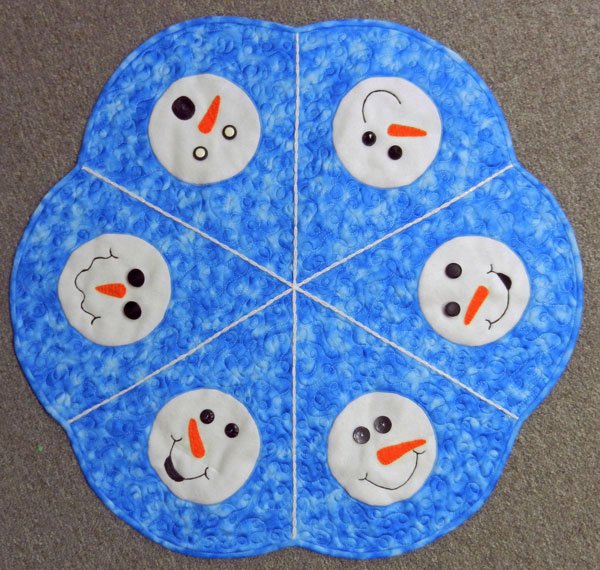
A kiss involves puckering and that can be a good thing:

But sometimes its better to pucker less:

This is especially true when machine quilting! Even if you use a walking foot those pesky puckers have a way of sneaking in on the top and on the back too.

Puckers appear when the 3 layers of the quilt sandwich shift under the pressure of the presser foot. Free motion quilting is one way to avoid some of the problem as the foot is not pressing down and thus things aren’t as apt to shift. But free motion quilting is not the answer for everone. So what can be done?

I’ve come up with a number of ways to minimize this problem. The first comes in on the pinning step. When layering your quilt, be sure the back is taut but not stretched. I’ve found the best way to do this on a small quilt is to use masking tape to secure the back to the table or floor (clamps along the edge of a table work well too). Once the back is taut, the batting and top may be smoothed on top and the pinning may begin. I’ve found this very helpful, but be careful not to stretch the back since this can cause the quilt to shrink up when the tape is removed and will lead to puckers on the front.

When pinning a larger quilt I prefer to use a simple frame made of 2 x 2’s, 4 chairs and 4 clamps. The frame is a great back saver. I may have to share pictures and directions for that in a future post, but if you’ve been in my open lab classes you already know how well this works :-).

Using a walking foot (sometimes called an even feed foot) for machine guided quilting is a must. This foot moves the top of the quilt along while the feed dogs move the bottom and this prevents a lot of the shifting, but it’s not always the complete cure.

I’ll share my favorite pucker prevention technique in my Thursday post. Until then do you have any suggestions to share?

PS Thanks to my family for humoring me in my pucker contest. I’m not telling whose pictured above, but it did provide a few giggles on Christmas Eve.

  • « Go to Previous Page
  • Page 1
  • Interim pages omitted …
  • Page 70
  • Page 71
  • Page 72
  • Page 73
  • Page 74
  • Interim pages omitted …
  • Page 76
  • Go to Next Page »

Primary Sidebar

Archives

Recent Posts

  • American Heritage Girls and a “Must Visit” Quilt Shop
  • Quilt, Slash, Create Again
  • Gone to the Light Side
  • Cross Quilts
  • An Interesting Plate

Recent Comments

  • Diane Edman on American Heritage Girls and a “Must Visit” Quilt Shop
  • Julie Savage on American Heritage Girls and a “Must Visit” Quilt Shop
  • Cynthia Huber on American Heritage Girls and a “Must Visit” Quilt Shop
  • judy raddatz on American Heritage Girls and a “Must Visit” Quilt Shop
  • Laura on American Heritage Girls and a “Must Visit” Quilt Shop

Categories

Footer

My Guide

Whatever you do, do your work heartily, as for the Lord rather than for men.

—  Colossians 3:23

Contact Chris!

  • Home
  • About
  • Gallery
  • Classes
  • Trips
  • Books
  • Blog
  • Contact
  • Sign Up For My Blog

Copyright © 2025 · Chris Quilts · Website by Adunate · Privacy Policy