• Skip to main content
  • Skip to primary sidebar
  • Skip to footer

  • Home
  • About
  • Gallery
  • Classes
  • Trips
  • Books
  • Blog
  • Contact
  • Sign Up For My Blog

Blog

Fitting Pieced Quilt Borders

November 17, 2019 3 Comments

Last week I shared instructions on how to create a twisted ribbon quilt border using Seminole piecing (click here to read that post). Now that we’ve found a simplified way to make this beautiful border – how do we get it to fit the quilt? Even though I love geometry, piecing that corner square didn’t look like fun to me at all. If you’ve taken my classes you know I want my quilts to turn out well, but I’m only willing to drive myself crazy to a point – then I find an alternate plan that will make me happy. That’s what I did on this quilt… Adding corner squares worked for me.

Getting the borders to fit the center of the quilt required some math, and THAT I was willing to do – by way of a slick trick I learned years ago: spacer borders!

Can you see I added an inner border in the rust colored background fabric around the original blocks in the photo above? This separated the center of the quilt top from the pieced border and gave me a great way to make the border fit (plus – it would have been very visually busy to have the pieced border snug against the pieced blocks).

The “spacer border” makes fitting the pieced border a breeze. To begin:

Measure your quilt top from side to side and subtract a 1/2″ to get the finished size. Mine was 20″:

Construct a border strip longer than the width of your quilt top. Measure this strip and subtract 1/2″ to get the finished size. Mine was 24″:

Subtract the center from the border. Mine was 4″. Divide this by half and add 1/2″ seam allowance back to this number. This is the width the spacer border needs to be cut. Mine was 2 1/2″. Sew these strips to the sides of your quilt.

If your quilt is square, use this measurement for the top and bottom also. If your quilt is a rectangle you’ll need to do this same process for the length of the quilt top to determine the width of the spacer borders to be added top and bottom.

Once the quilt top has the spacer borders attached, the twisted ribbon borders can be added top and bottom. To add the pieced side borders:

Cut 4 corner squares from the ribbon fabric at the same measurement as the width of your pieced border (mine was 3″). Sew these squares to the ends of the side border strips. Sew the side borders on.

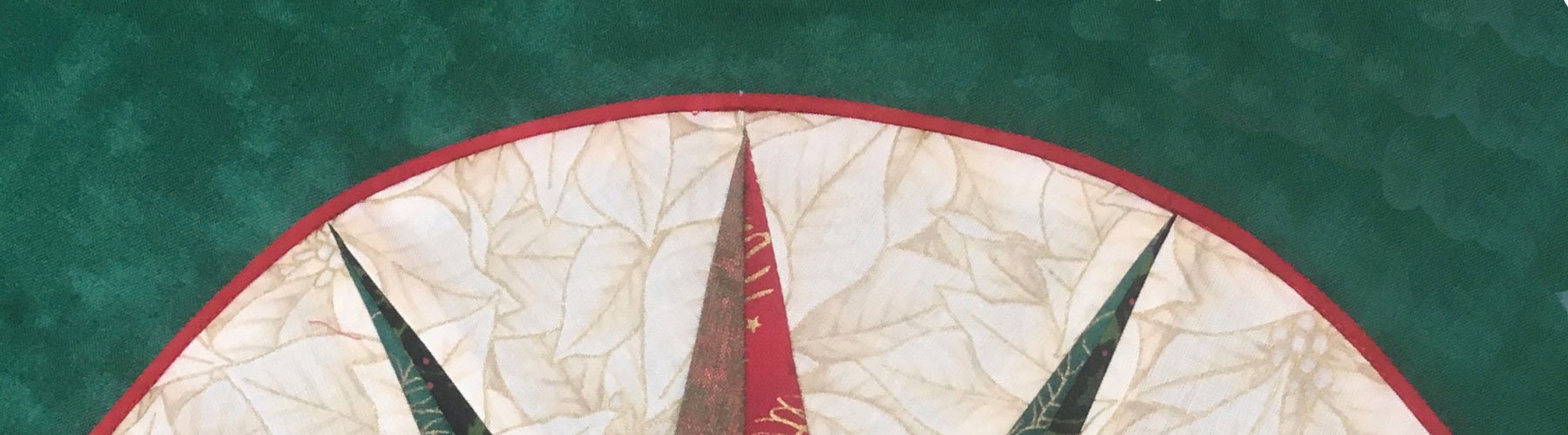
Once the pieced borders were on, I added another border in the rust colored background fabric to complete the twisted ribbon effect, and framed it all with a larger border of the print fabric from which my original Spin Star blocks were made. It was a beautiful fabric for the final border, and I think it made lovely stars!

I love adding spacer borders because it allows me to make the pieced borders whatever size I like – then adjust the quilt size to fit the borders. It’s a helpful trick to have in your toolbox!

A Fun Twist on Borders

November 10, 2019 13 Comments

I taught my Seminole Sampler workshop a few weeks ago and after lunch Carmen showed me a photo of a recent quilt she’d made. It had a twisted ribbon border and she said it was such a pain to piece she only bordered it top and bottom.

I too attempted to use this border on a quilt years ago, and I gave up. But, as I looked at Carmen’s quilt, it occurred to me that I might be able to Seminole piece it. I was right! And it is much easier than it looks!

To begin, let me share what I call a simple Seminole border. It looks like a row of squares on point.

This may seem complicated, but the trick is strip piecing. Here’s the step-by-steps from my handout (with instructions in the caption):

You simply sew three different fabric strips together into a strata, crosscut units off at the same width as your original strips, sew pairs together – jogging the top unit down one seam, sew all these pairs into a strip, and trim off the triangles.

Making the twisted ribbon border is fundamentally the same process, with one simple change. Here’s the quilt that resulted from this experiment:

And here’s how it’s done:

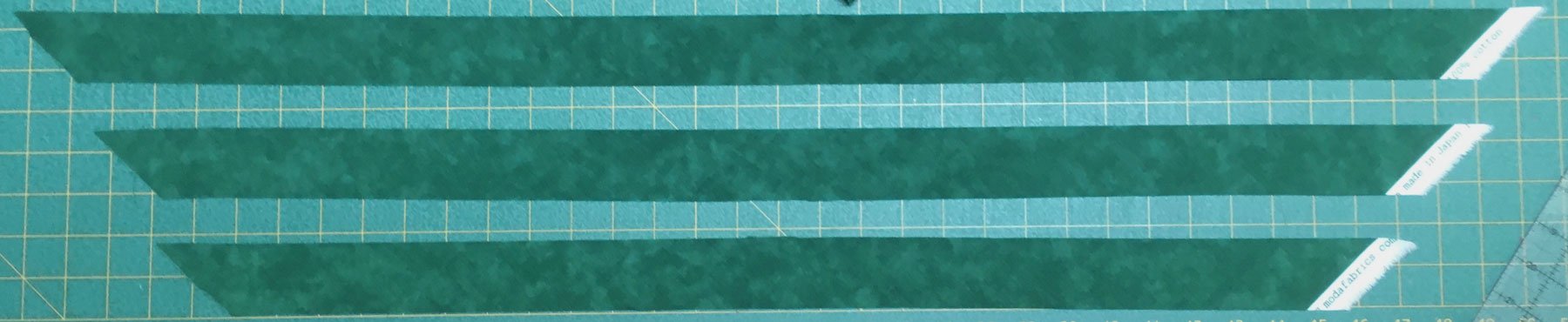
Choose 3 fabrics: a light background, a pretty ribbon fabric, and a fabric for the “back” of the ribbon. This border can be done many sizes, but to make a sample I used 2 1/2″ strips.

Cut: 2 light background strips, 1 ribbon strip and 1 back of ribbon strip.

Sew: a background strip to each side of the “back of ribbon” strip and press towards the dark.

Cross-cut pieces at 2 1/2″ (or whatever your original strip width was)

Measure these pieces (mine measured 2 1/2″ x 6 1/2″), and cross-cut as many pieces from the ribbon fabric strip at this measurement as you are able. Lay out the seminole border, alternating the pieced units with the “ribbon” rectangles:

I hope you can see that the layout is the same as for the simple Seminole above, the only difference is that every other unit is a full piece of the “ribbon” fabric.

So how do you know how far to jog the top strip down when you sew the pairs together without seams to match up? Simply offset the end of the “ribbon” unit by 1/4″:

Flip the “ribbon” unit on top of the pieced unit and stitch into pairs:

To line up the pairs for stitching offset the lower end of the “ribbon” unit by 1/4″:

Flip and sew once again. To make “foursies”:

Continue in this manner until all the pairs are connected into a border strip. Then trim off the triangles on each side of the strip, 1/4″ from both sides of the “back of ribbon” squares (mine are the black squares):

Make sure your strip is a consistent width when you trim the second side.

Also, be careful with these trimmed strips because the long edges are all bias. I find it best to sew them to the quilt right away. If that’s not an option, stay stitching the long edges would be wise.

To square off the strip, cut squares from the background fabric (mine were 3″), then cut them in half diagonally:

Sew one to the end of each border strip:

Next week I’ll share how to make these borders fit on your quilt!!!

Leaving you with a smile!

I try not to include pics of my grandkids too often, but this week I just couldn’t resist. For those of you not in southeastern Wisconsin – it’s been a very unusual Autumn here. We had a blizzard on Halloween! And less than a week later we got hit with another 4″ of snow! The kids loved it. Trey and I made a snowman after school last Wednesday (he’s in 4K) and there were plenty of leaves stuck in the snow:

Then we got the great idea to swap heads with the pumpkin he helped me carve:

He breaks me up!

A Bricks and Mortar Quilt

November 3, 2019 7 Comments

If you’ve been quilting for a while you’ll recognize the name Mary Ellen Hopkins. She was a very creative quilter, with a great sense of humor and a gift for teaching. The first book of hers I owned was “It’s Okay if You Sit on My Quilt.

She was the originator of what she called the “Connector Block” technique. You may know it better as “Slap Back Triangles” – sewing a small square diagonally in the corner of a larger square to add a corner triangle. It’s a great technique I’ve used many times.

She inspired me with many other techniques and patterns. Way back in the 90’s I attended a group at a shop named “On Pins and Needles” in Sauk City, WI. It was a Mary Ellen Hopkins group called “Quilt Sitters Circle”. In it the owners shared loads of great ideas from Mary Ellen. I was even able to attend a lecture by Mary Ellen in Milwaukee. I learned so much there, and one of my favorite patterns was “Bricks and Mortar”. I made a quilt for my son’s bed using it (he was 9 then and is now 37).

I recently pulled out this pattern to make a quilt for my nephew Kevin and his wife Aly. You may remember me making them placemats for Aly’s shower back in August (to read that post click here). They actually were married before they left for their time with the Peace Corps in the Gambia, and yesterday they finally had a reception so family and friends could gather and celebrate them as a couple.

For their “wedding” quilt I pulled out another piece of the African fabric they brought me after their adventure.

I chose the colors for the quilt top from this fabric. It was too beautiful to cut up. I made the top from those fabrics at my guild retreat a few weeks ago.

Here are the measurements for the Bricks and Mortar pattern, in case you’d like to make one of your own:

The center square was cut 5 1/2″; the cornerstones 3 1/2″; the mortar strips 1 1/2″ x 3 1/2″; and the bricks 3 1/2″ x 5 1/2″. It’s constructed “log cabin” style. Everything fit together beautifully and it was an easy and fun pattern to make!

I finished it up mere hours before their celebration, and forgot to take a picture of it before I popped it into the gift bag. I will hopefully get a photograph of them with their quilt to post next week ?.

Have you made a Bricks and Mortar quilt? Do you have any memories of Mary Ellen Hopkins you’d like to share?

Stitched Circles

October 13, 2019 7 Comments

Many sewing machines have a circle maker for stitching circles onto fabric. I took a class in this technique from Libby Lehman at the AQS show in Paducah years ago. She was an absolutely wonderful teacher, and I was blessed to have taken many classes from her. Sadly, this was the last one prior to her stroke in 2013. Libby was an inspiration to many and her energy, talent, innovative quilts, and crazy sense of humor are truly missed by many of us.

I think of her whenever I look at quilts of mine which she inspired. The samples from her circle class are among those.

I share them in my “Going Round and Round” lecture and the last time I presented it I decided the time had come to put them into a quilt. The kit for the class included some of Ricky Timm’s hand-dyed fabric, we brought along our own variegated threads and… here are the sample blocks I made – up close and personal:

To make the above blocks we layered 2 squares of fabric and used the circle technique to straight stitch 3 circles of different diameters. We then cut away the top fabric from the center, and from the last “ring”. The fun began when we covered that straight stitching with decorative stitches and beautiful threads.

Our first decorated block was made with just a single layer of black fabric, so the circles of stitches are very obvious. Then we jumped into the colorful ringed pieces.

I learned a great hack for doing this type of stitching without the fancy gizmo for the machine, and it’s a lot of fun! Here’s what you need to try it:

  • a sewing machine with fun pre-programmed stitches (these are the stitches we want to play with, but seldom have a use for ?)
  • a 9″ square of fabric
  • a 9″ square of stiff tear-away stabilizer, or plain paper (I like to use scrap sheets from my printer)
  • variegated or bright colored thread in a variety of colors
  • a flat head thumbtack
  • a 2″ square of thin cardboard (cereal boxes work well)
  • clear mailing tape
  • a rubber eraser pulled from a cheap mechanical pencil

1. Fold the fabric square in half and then quarters to find the center. Mark with a pin. Secure the back of the fabric square to the stabilizer/paper square with a light spritz of spray baste, or pins in the corners.

2. Push the point of the thumbtack through the center of the cardboard square,

and place this on the bed of the machine, thumbtack point up, directly to the left of the needle, with the point of the tack half the diameter of your desired circle from the needle (this is called the radius – for a 6″ circle, the tack will be 3″ from the needle). Be sure the tack is directly to the left of the needle. Secure to the bed of the sewing machine with mailing tape, pushing the point through it.

Front view
Side view

3. Push the eraser over the point of the tack to protect your hands until you’re ready to sew.

4. Thread the machine with a pretty thread on top, and a thin polyester thread of similar value in the bobbin. Set the machine for a fun, decorative stitch.

5. Place the marked center of your fabric square onto the thumbtack, right side up. Lower the presser foot and begin to stitch – hands free! This may seem counterintuitive, but the feed dogs will pull the fabric under the presser foot while it pivots around the thumbtack, thus creating a stitched circle.

You may need to adjust the stitch length the last 1″ of each circle to get the stitch pattern to match (this takes a little practice).

Once a circle is stitched you can move and retape the tack a different measurement from the needle, change the thread and chosen stitch (or keep it the same), and create another circle. It’s loads of fun – and sew very simple!

Next week I’ll share an exciting way to put the blocks together – Quilt As You Go!

Birthday Quilt – Done!

October 6, 2019 7 Comments

It is with joyful thankfulness I get to post about my birthday quilt!

Many of you may remember sending me blocks for my 60th birthday because of an invitation from my dear friend Wendy. To read that post click here! You may also remember that I received 60 4-patches by the end of October that year (click here for that post ?).

Around that same time I was playing with scraps and made them into a unique lone star.

I loved the colors and the incredible scrappiness! I did a blog topic on this technique too! Click here to visit that post.

The week after I made the star my ThreadBenders group had challenged us to bring in UFO’s that we liked, but didn’t know what to do with. I brought my birthday blocks and my star. The general consensus at the meeting was to put them together ~ BRILLIANT!

I loved the idea, but all the parts sat in a pile (I’m sure you’ve never done that ?), until a few months ago when I decided I wanted to finish my birthday quilt in time for my 63rd birthday. And I did!

I love it! I put minky fleece on the back so it was super snuggly, and no batting. This made the quilting a bit challenging, it is slightly puckery on the front, but the back looks really cool (sorry for that adjective – it just fit):

The stitching shows up even better in low light:

As you can see, the backing green didn’t match the front, so I had to put a black binding on to separate the two. It’s fun and perfect for these cool Autumn nights.

The best part? Reading all the names and wonderful messages/Scripture verses many of you sent to me. Every time I wrap up in it, I feel like I’m hugging so many dear friends. You are all a blessing to me!

*****************

European Christmas Markets Cruise Update!

For the first time in all of our travels ~ we’ve had as many couples sign up for the cruise as quilters. This means quite a few men will be traveling with us on the Christmas Market cruise. We still have a few cabins left, and they need to be claimed this month (the deposit is due when booked, but the rest of the monies aren’t due until next year)! So, if this was a trip you thought of doing someday but wanted to do it with your husband, join us.  We promise, he won’t feel out of place ?! Then contact Kristi and sign up soon! Click here for all the details!

3 – D Fiber Art and Spinning Stars

September 29, 2019 2 Comments

The small challenge in our ThreadBenders group this year was called 3-D Boxes with Covers. Here are the rules:

“The box may be any shape and made from any material. It must be no smaller than a 6″ cube and no larger than a 15″ cube. It must be able to stand on a table on it’s own. At least one side has to open and the inside must be visible. Some portion must be quilted (three layers held together with stitching).”

The resulting pieces are a fascinating array of unique containers made by a very talented group of fiber artists. You can see them all at: https://threadbendersblog.wordpress.com.

Making my “box” was an adventure and I’d like to tell you a bit about it.

I had no idea what to do at first, so I decided to go through my UFO bins and find an unfinished project that was yelling for me to do something with it. What surfaced was 4 “Spin Star” blocks made with a wild Jane Sassamann fabric.

I needed to make one additional “Stack and Whack” style block, leaving the bottom of the box available for a piece of the original fabric – so everyone could see what the blocks started from.

The rules stated that the box needed to have a portion that opens to reveal the inside. I decided to have an entire corner of my box open. This presented some interesting logistic problems. Three sides of my cube could be finished as simple squares before putting the box together. That would be the fabric on the bottom of the box, pictured above, and these 2:

The remaining three sides needed to be made as 3/4s of a square, with the last 1/4 finished separately so it could swing open.

To make the sides stiff I used plastic mesh canvas, batting, and Pellon Decor Bond™. I layered each block with the batting and quilted it first. Then I put the rest of the layers together and beaded through everything to hold them all in place. Once each side was complete I sewed it all together by hand.

Three flaps open in a top corner to reveal the inside. I found the box was still a bit wobbly at this time, so I glued in some wooden stabilizers (painted black).

The flaps struck me as boring, so I decided to make them more interesting by adding a portion of one of my favorite Scripture verses to each: “Ask and you shall receive, Seek and you shall find, knock and it shall be opened onto you” Matthew 7:7. It fit well on the three “doors” of my box.

The closure was a bit tricky. I glued flat glass beads onto pins, stuck them into the edge of the flap, then I attached metal rings to clasp them.

The “doors” didn’t lay as smoothly as I had imagined, but it was my first attempt – and I can live with it ?.

I learned a lot along the way and love my new piece of art. Sommer and Trey keep wanting to fill it with toys, but that will have to wait until after our 3D boxes have been exhibited. If you know of a venue that would like to show all of our pieces, please let me know.

****************

Class update!

My Spin Star class has been one of my most popular workshops over the years. In it we make 4 blocks that can be placed in a table runner or wall hanging. And it’s amazing how different they can each be!

I’m scheduled to teach it again at Sew Much More in Waukesha on Friday, October 11th. Click here for all the details!

While you’re there, please check out my “Snow-people Topper” class too. I’ll be teaching it on November 22nd.

The batting in this project is polar fleece, and it peeks through to make the faces.

Quilting really makes me smile!

Squash Books

September 22, 2019 1 Comment

Wendy and I recently hosted a reunion for quilters who have traveled with us on any of our past eleven trips.

We asked them to bring along their projects and photos from their travels, and it was a lovely time for remembering.

One of the projects I taught for both our riverboat cruise through France and our bus tour of Ireland was something I call a squash book.

I had actually forgotten all about them, but when Nancy pulled hers out at the reunion – it came back to me. Then another Nancy asked for the pattern and I had to go digging. The problem was – I had written up a class handout, but there were no pictures or diagrams. At that point I knew I had another blog topic!

From the outside they look like a square, fabric wrapped package, but when they are opened the fun begins.

They are small photo albums! If you’d like to make your own, here’s what you’ll need:

To make the covers:

°Place 1 cover fabric, wrong side up on the work surface.

°Center a piece of cardboard on the wrong side of the cover fabric.

°Hot glue 1/2” area along one edge of cardboard and fold fabric up onto the glue. Repeat for the opposite side (this book has different fabric – and cardboard – front and back. Both made the step-by-step pics, above and below, the instructions are the same. I apologize if it’s a bit confusing).

On one of the remaining sides: glue the edge, fold fabric corners in and fold fabric up, onto hot glue “gift wrap” fashion. (in the previous photo the sides have been glued in place and the bottom has the corners folded and is ready to be glued in place on the cardboard)

°Repeat for last side (the top edge on the above photo). Then repeat all steps to make the other cover.

To make the pages:

°Cut all 3 card stock pages into 8” squares.

°Fold each page into halves and quarters, open and fold along 1 diagonal.

°Lay pages in a row with the 2 outer pages – points down, the middle page – points up, and the diagonal creases all going vertically.

°Nest the left square of the middle page over the right square of the left page (these squares have no diagonal crease). Glue together with rubber cement (I brushed rubber cement on both my green and white squares for a good bond)

°Repeat with the right square of the middle page over the left square of the right page. Let dry.

Putting it all together:

°Place the front cover against the square to the left. Apply fabric/paper glue evenly to the back of the paper page and center it on the cover. Press firmly for a few minutes to hold it in place.

°Carefully repeat these steps for the back cover (being sure the front cover stays in place), but add a ribbon to this cover by folding the ribbon in half to locate the center and placing this on the wrong side of the back cover, centered horizontally. Apply glue and position book pages on the back cover. Accordian fold the book together and place a heavy object on top while the glue dries on both covers. This image shows how the ribbons should be glued between the layers on the back cover:

Filling your squash book:

° Resize photos to fit and print them onto presentation paper (photo paper and cardstock are too thick to work well in these books). Cut out the pictures and glue them in place with a glue stick or other good paper glue. Pre-creasing pictures, and/or cutting off corners, will help them to fit over page creases. Here are a few snaps of my books to make this clear:

France book – cover side
France book inside
Ireland book – inside left cover (note the cut off corners and creases in some of the photos)
Ireland book – center page
Ireland book – inside right cover

These books are great fun, and can be made for all sorts of reasons and occasions. I hope you decide to give it a try – and please send me photos if you do!!!

And just a quick note –

We still have a few cabins left for our Sew We Go riverboat cruise to the European Christmas Markets in December of 2020. Please be aware – it may sound like a sales pitch, but this trip is unique.

This cruise will sell out before the end of the year. Ama Waterways knows this and only gives us a small window of time to sell the group cabins we have reserved before they take them back.

You won’t be able to sign up at some point next year because our cabins will be gone. So if you are interested in going, please sign up very soon! We’d love to have you join us and we’d hate to give any of our cabins back ?!

For all the information and the application form click here!

A Sashiko Jacket

September 15, 2019 2 Comments

Last week I posted photos of my friend Evelyn and I wearing the new jackets we made together.

I promised the story – and here it is!

Evelyn has always loved Asian fabrics and designs. She has a wonderful collection. Years ago she made a jacket using a pattern by Bette Gant.

Evelyn’s jacket front
and back.

She covered it with exquisite machine stitched sashiko.

She loved that jacket – and she wore it out! From the stitching to the cuffs.

Evelyn’s friend Judy is a travel planner who was looking for a tour leader for a trip to the International Quilt Festival in Japan, and Evelyn gave her my contact information. When I signed on for this wonderful trip, Evelyn shipped an exciting package of goodies to me from her home in Arizona. It was filled with Japanese books, fabrics and stencils. Then, when she came back to Wisconsin for the Summer, we got together to make jackets: she needed a new one and I simply needed one!

Evelyn chose to put appliqué on the back of hers this time, and I dove into the stack of fabric she had sent me to fill the spaces.

As I cut and fitted the pieces together I mentioned to her how much I liked the two blue pieces printed with sashiko patterns. That’s when she told me those designs were marks to be stitched and they would wash away. Yikes! Time to learn to do sashiko! I stitched the dark blue area at the top with red thread, and the lighter blue area on the lower right with two different colors.

And here’s a close up of before and after stitching:

I found this stitching very addictive and decided to stitch it onto the sleeves too!

I covered the “seam” lines on the back with bias strips of the blue denim fabric and decided to keep the jacket front simple.

It took three lessons to complete my jacket, and I love it! I’m sure it will come in quite handy in Japan, since it will be winter there. Praise the Lord their winters are milder than ours are here in Wisconsin.

Thank you Evelyn! For your generosity, teaching skills and friendship!

************************

I’m about to send out my pre-trip, “let’s get excited”, blog posts to the quilters who have signed up to travel with me to Japan. I’ll be sharing information about the things we’ll see, the food we’ll eat, and the projects we’ll create with them via a special blog over the next few months. There are still a few spots left for my trip to Tokyo this January. Please click here for all the information!

************************

Upcoming Class Corner

As many of you know, WCTC will be discontinuing their Adult Enrichment Classes after this semester. I’m sad that it will be my final semester after 22 years, but excited about the workshops I still get to teach! My Open Labs are full, as is my Goose Tricks class. I still have openings in three Friday workshops:

Compass Capers is this coming Friday, September 20, 2019, from 9 – 2:30. Sorry for the late notice, but I do have 4 spots left, so if you’re available – I’d love to have you join me.

Seminole Sampler is on October 18th from 9 – 2:30. This class needs 2 more students to run. I already have 8 in the class so I’d hate to have to cancel them out, so please consider grabbing a friend and learning a bevy of fun border techniques. I promise – you won’t be disappointed.

Repliqué Joy is on Friday, December 13th from 9 – 2:30, and it also has 4 spots available.

For descriptions of all of these classes, and to register on-line go to: https://www.wctc.edu/, click on “Course Search”, type quilt into the course box and click on “Find Courses”. Click on the name of each class for a description to pop up. Then register on-line or call 262.691.5578.

  • « Go to Previous Page
  • Page 1
  • Interim pages omitted …
  • Page 37
  • Page 38
  • Page 39
  • Page 40
  • Page 41
  • Interim pages omitted …
  • Page 78
  • Go to Next Page »

Primary Sidebar

Archives

Recent Posts

  • Squirrel!
  • Bird Quilts
  • Crazy Quilters 2026
  • Spring Thaw
  • Quilting in Bloomington ~ Part 2

Recent Comments

  • Laurie Neubauer on Squirrel!
  • Mary Wedor on Squirrel!
  • judy raddatz on Squirrel!
  • Gail on Enlarging a Finished Quilt
  • Doris Rindfleisch on Bird Quilts

Categories

Footer

My Guide

Whatever you do, do your work heartily, as for the Lord rather than for men.

—  Colossians 3:23

Contact Chris!

  • Home
  • About
  • Gallery
  • Classes
  • Trips
  • Books
  • Blog
  • Contact
  • Sign Up For My Blog

Copyright © 2026 · Chris Quilts · Website by Adunate · Privacy Policy